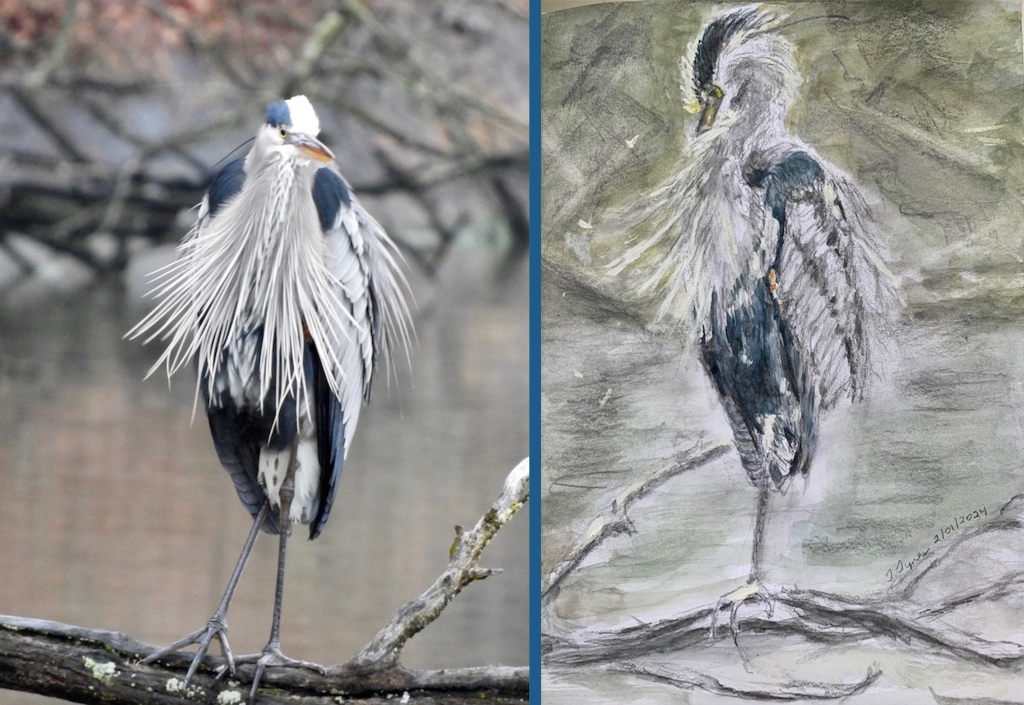
A most beautiful Great Blue Heron has been frequenting the Salt Marsh lately, with many local social media posts to prove it. A winter visitor, this particular heron has taken to perching near the shore or on one of the Inwood Hill Park docks. It can easily be seen up close. In a cold gray landscape, its presence is most welcome.

Great Blue Herons, as winter visitors, will be fine here as long as the water doesn’t turn to ice and they can forage. A salt marsh is a perfect environment for them. The New York State Department of Environmental Conservation’s website lists Inwood Hill Park as one of the best places in New York State to see Great Blue Herons.

With its long chest feathers, this is certainly a mature Great Blue Heron. When perched on an old fallen tree near the banks of the Salt Marsh, it often takes time to meticulously groom its front feathers. The heron is bluish-gray like others like it, with black and white streaks on the front, yet these blue-grays look exceedingly vibrant in winter light.

The plumage of a Great Blue Heron is complex and delicate, with light gray flight feathers, scapular plumes on the wings, and fine feathery chest hairs. The black pin plumes on the top of the head are called occipital plumes. The heron often preens or combs its feathers in order to remove oils or to prepare for flight.
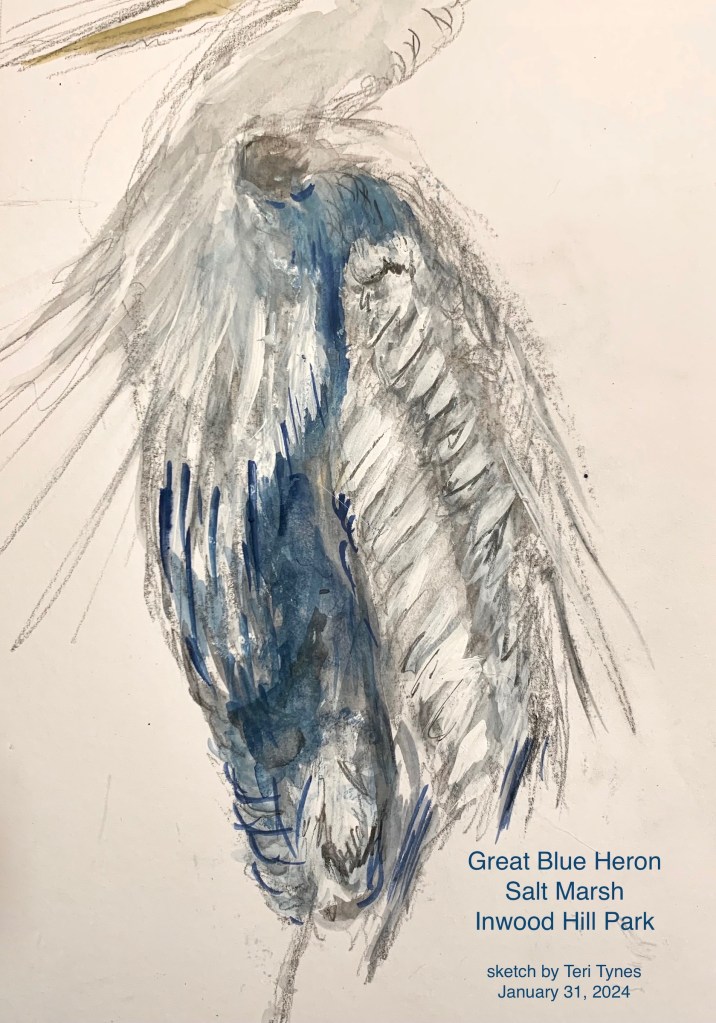
I was inspired to spend more time with the heron in my sketchbook practice. The Great Blue Heron is the largest heron in North America. It has a six-foot wingspan, at least, and I stopped counting how many feathers to draw. The range of its blue tones impressed me. Blue is a tricky color to process visually, as blue wavelengths are short and visible to the eye only due to scattered sunlight. (See the post The Blues of Blue Jays for a related exploration.)

For the painting of the Great Blue Heron in the marsh, I wanted to show a bit of the motion of the heron preening its feathers. Many little feathers were flying everywhere. The big bird needs working feathers for the flight.

Artwork by author. Mixed media – water-soluble graphite, watercolor, and gouache on 7 x 10 inch Canson mixed media sketchbook paper. See Artwork page for more examples.
Related posts
The Greatest Blue Heron Show on Earth
Fishing Lessons with the Great Blue Heron
The Ebb and Flow of Egrets and Herons
Two Herons in the Stillness of Dusk
Recent posts
- Herons in Trees: Watching and Waiting at High Tide
- A Green Heron Joins the Other Dinosaurs, and the Pursuit of the Big Picture
- Sporting Colors: The 2026 Baltimore Orioles Season in Inwood Hill Park
- Field Notes from the 2026 Cedar Waxwing Gathering in Isham Park
- Birds in the Garden of Eden: A Field Trip to Untermyer Park and Gardens in Yonkers, New York
 Birds of Inwood
Comments welcome!