
Like most warblers, the American Redstart is a petite bundle of energy unwilling to sit still for pictures. It appears in quick flashes, a blur of black and orange (the male) while flitting from tree to tree to forage for insects. Though dressed in the colors of Halloween (a frequent characterization), American Redstarts are rarely scary, except intentionally to one another during territorial fights. I suppose they also scare the insect kingdom, as they fan their expressive tail in order to drive out bugs from the leaves.

I was first made aware of their presence through Cornell’s Merlin app. For the past several seasons, I would pick up their sound in the trees west of the athletic fields in Inwood Hill Park and near the entrance of the Clove. Their quick high chip notes help distinguish them from the regular cast of the old-growth forest. I would hear them but never see them, though the bird guides claim the American Redstart is more conspicuous than other warblers.

I’ve changed my approach to finding American Redstarts over the past two weeks, and I am happy to say that I have actually seen them now and in more places. Leaving the sound function open for recording, I have familiarized myself with their song and therefore more able to follow their quick movements.
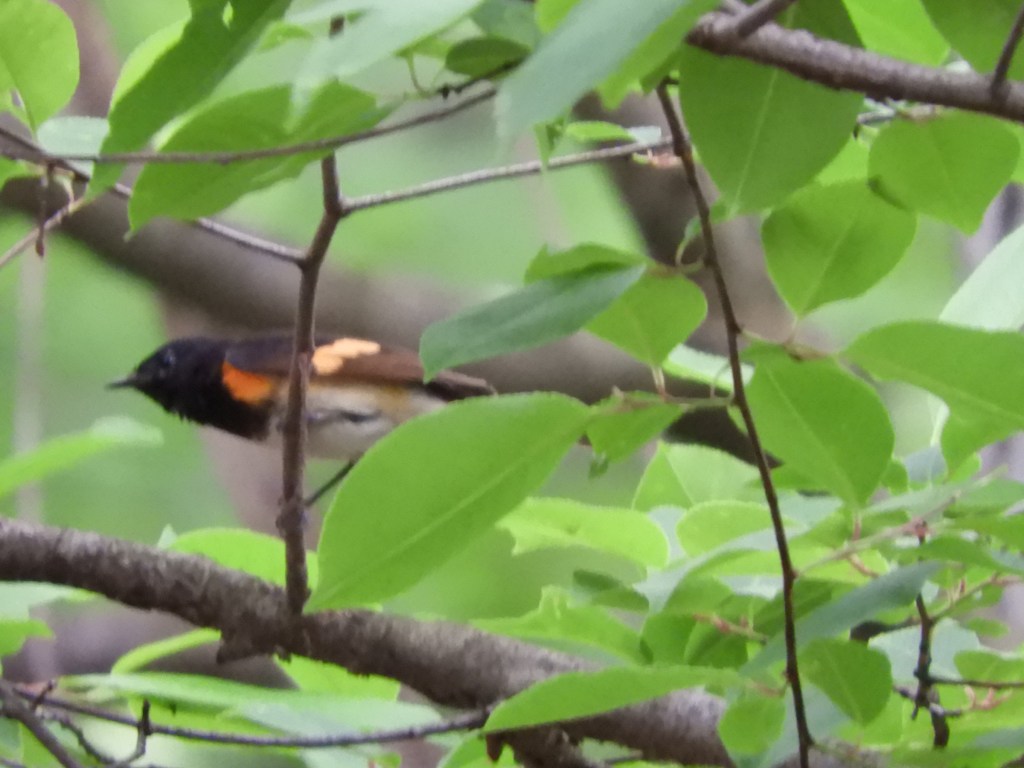
My first up-close encounter with American Redstarts occurred on an early evening walk on a trail that winds underneath the Henry Hudson Bridge and emerges on the west side with views of the Hudson River. In the golden hour before sunset, a male redstart appeared close to the trail in a small sapling, a favorite perch for this type of warbler. (cover image and top pictures from May 11, 2023)

The light of the setting sun enhanced its orange flashes. That evening we didn’t have a particularly colorful Hudson River sunset, the stuff of the famous school of Hudson Valley landscape painters, but the effect of the light was pleasing enough. In Spanish, they are called Candelita Norteña. In French, they are Paruline flamboyante.

In the following days, I saw an American Redstart up on the easternmost ridge near the end of 207th Street and also along the carved stepped path that descends from Inwood Hill down the Clove. As the male American Redstart is polygamous and may maintain separate territories, I may have been seeing the same bird over and over again. In the fall, the American Redstart will return just in time for Halloween preparations.
Cover photo: American Redstart in early evening. Inwood Hill Park. May 11, 2023
Recent Posts
- Herons in Trees: Watching and Waiting at High Tide
 Many of my favorite heron sightings these past few weeks have occurred at high tide. While it’s more common to spot herons wading through the waters during times of low tide, abundant fish during the late summer keep the herons nearby. They watch and wait, frequently grooming their feathers. Look for them in trees or… Read more: Herons in Trees: Watching and Waiting at High Tide
 - A Green Heron Joins the Other Dinosaurs, and the Pursuit of the Big Picture
 A lively Green Heron has been drawing attention this summer at the Salt Marsh in Inwood Hill Park. While not uncommon for late summer, this member of the heron family stands out among the Great Egrets, Great Blue Herons, and Black-crowned Night Herons. For one, the Green Heron is of slighter skeletal build compared to… Read more: A Green Heron Joins the Other Dinosaurs, and the Pursuit of the Big Picture
 - Sporting Colors: The 2026 Baltimore Orioles Season in Inwood Hill Park
 Several Baltimore Orioles made their way back to the high trees of Inwood Hill Park this year. They’ve been building and attending nests at the edges of the park. The female builds the nest over the course of the week, while the male goes out on foraging errands. The orioles usually stake out the same… Read more: Sporting Colors: The 2026 Baltimore Orioles Season in Inwood Hill Park
 - Field Notes from the 2026 Cedar Waxwing Gathering in Isham Park
 Dozens of flocks of colorful Cedar Waxwings have arrived in Isham Park in Northern Manhattan for their annual feasting of the Juneberry trees (Amelanchier is the scientific name, or serviceberry). The festive occasion takes place during late May and early June and lasts as long as the bright red berries are consumed. While Cedar Waxwings… Read more: Field Notes from the 2026 Cedar Waxwing Gathering in Isham Park
 - Birds in the Garden of Eden: A Field Trip to Untermyer Park and Gardens in Yonkers, New York
 At Untermyer Park and Gardens in Yonkers, NY, on May 18, I didn’t see many birds out of the ordinary. I was so taken in by the dramatic vistas of the park and garden that I may have overlooked them. Tens of thousands of birds migrate north of New York City each spring and… Read more: Birds in the Garden of Eden: A Field Trip to Untermyer Park and Gardens in Yonkers, New York


Comments welcome!