
Black-capped Chickadees, the famously cute and clever birds of the northern latitudes, have been everywhere in Inwood Hill Park this past week. I’ve seen them flitting about trees in the sunken willow corner of the marsh path, perching on low branches on top of the W. 207th steps, jumping around trees on the trail leading up to the Henry Hudson Bridge, and swinging on tall grasses in the marsh regeneration area.

They are excellent foragers, grabbing seeds as fast as they can. In the eastern range of North America, they may be found throughout the Appalachias from Georgia to the Adirondacks. They do well in winter as they can lower their body temperature and also cache food. More on that later. They frequent trees and shrubs looking for insects as well as seeds.

Baby chickadees take just a couple of weeks to look like adults. Males and females are similar and hard to discern. Black and white and buff, the small birds sport a black cap that covers their eyes. This masking makes their eyes hard to see.
Chickadees are often found at the edge of the forest habitat. They prefer mixed and deciduous forests and marsh areas. Listen for their fee-bee sounds and more complex vocalizations.
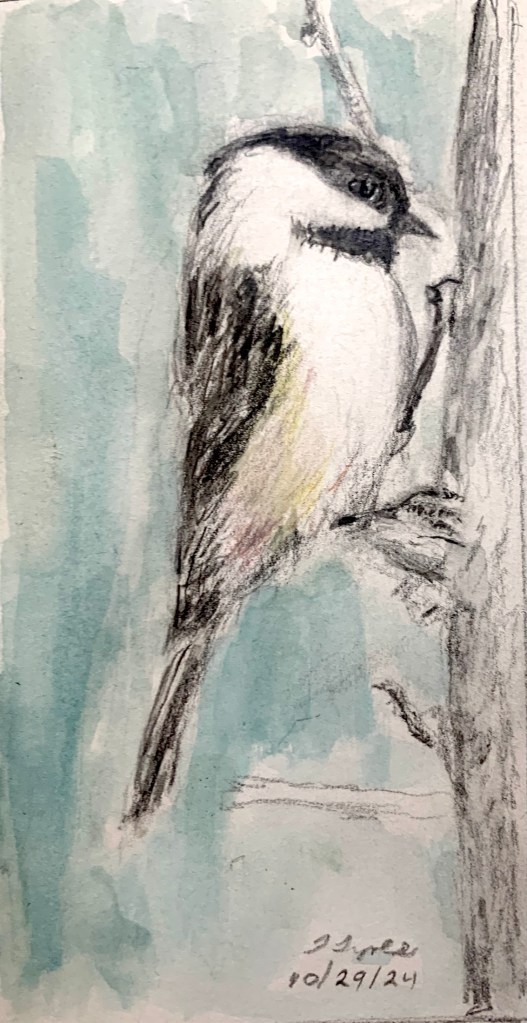
Image: Study of a Black-capped Chickadee by author. Water-soluble graphite, gouache, and colored pencil. 6″ x 3″ on mixed media sketchbook paper. October 29, 2024.
Black-capped Chickadees don’t migrate, but flocks of young birds may move to adjacent territories. These “irruptions” are often due to habitat loss or food shortages. Sometimes, a good breeding season may send the young ones to nearby habitats. I didn’t see many chickadees here last winter, so something like one of these local migrations may be underway.

Highly social birds, Black-capped Chickadees can be friendly with humans. None of them shied away from these pictures. They also do well in company with titmice and nuthatches. Researchers have discovered that chickadees, titmice, and nuthatches benefit from one another, collectively using their traits to use feeders or to defend themselves from predators. (See article on Carolina Chickadees by Todd M. Freeberg from the University of Tennessee.)

Black-capped Chickadees are a popular subject for researchers especially for their ability to store and remember where they hide their food. Dmitriy Aronov, a neuroscientist at the Zuckerman Mind Brain Behavior Institute at Columbia University, studies their “episodic memory,” the ability to recall specific incidents in the past. The work involves studying neural patterns in chickadee brains as the birds store and later find their caches. According to his research, in order to keep track of their food caches, the birds can store memories in the thousands. (See article, “The Brain Science of Tiny Birds with Amazing Memories” in the Duke Research blog. )

Inwood Hill Park provides just the right mix of habitat for these Black-capped Chickadees. Remember when you see them that they store some brilliance under those cute little black caps.
Cover: Black-capped Chickadee. Marsh regeneration area. October 28, 2024. 8:54 a.m.
October sightings
Along with the chickadees, the Tufted Titmice and White-breasted Nuthatches have been making the rounds of the park. See the October 2024 sightings page for more. I regularly update the sightings pages, at least after every walk.
Latest posts
- A Green Heron Joins the Other Dinosaurs, and the Pursuit of the Big Picture
- Sporting Colors: The 2026 Baltimore Orioles Season in Inwood Hill Park
- Field Notes from the 2026 Cedar Waxwing Gathering in Isham Park
- Birds in the Garden of Eden: A Field Trip to Untermyer Park and Gardens in Yonkers, New York
- An Evening Walk with a Great Egret, and Spring Migration Report
 Birds of Inwood
Comments welcome!