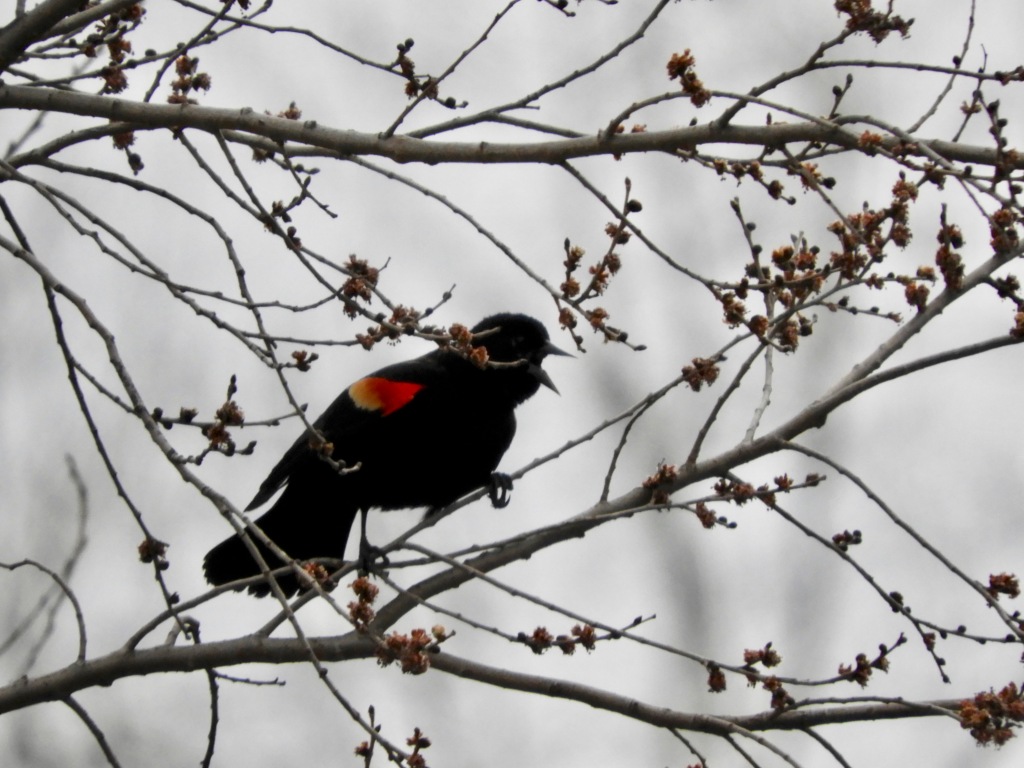
Red-winged Blackbirds returned to the Salt Marsh of Inwood Hill Park last week, the week beginning with the start of Daylight Saving Time on March 10. These birds are often heard before they are seen, with throaty repetitive shrieks, and the water at the Salt Marsh helps carry their signature calls. As they cried out to claim their territory, they displayed their characteristic fiery red and orange epaulets.

I first observed a Red-winged Blackbird on the early morning of March 10. They are black as night when still, but I clearly saw one in the morning light. A black silhouette clung to one of the many straw-colored reeds. A few days later on March 13, again in the early morning, I saw one a little more clearly (above), the same black form but showing the fiery wing patch with its cries. Its eyes were nearly indistinct in its inky head, and I was not able to see the round dark eyes clearly until I took a favorably-lit picture of one on March 16 in the late afternoon.

While closely observing one on March 14, I was impressed by its insistent vocalization. It grew hoarse with the effort, straining to be heard. By then, two Red-winged Blackbirds found themselves in a territorial struggle over homes in the Salt Marsh. I watched their orange and red shoulder patches swell and then disappear in rhythmic succession. I found myself a little exhausted on their behalf. More Red-winged Blackbirds could appear soon, as they tend to roost in flocks.

Gouache, water-soluble pencil, watercolor wash, and gel pen on 6″ x 8″ paper.
When I sat down to paint the Red-winged Blackbird on a small sheet of mixed media paper, I looked forward to dipping my brush in the strongest intensities of black gouache. I found their bills to be thin and cone-shaped, with their robin-sized silhouette a little crouched. Those badges at the shoulders were delightful to paint, with no need to water down the bright scarlets, oranges, and yellows.

Last May, I found a female Red-winged Blackbird in the same fenced-in marsh area where I first saw the male this year. At the time I did not know what it was, and it took a few hours for me to identify the bird as the female of the species. This year, I should be ready for her when she appears. The female will choose the nesting site, preferably near the water line in the marsh, and weave a nest among upright stems.
Red-winged Blackbirds are typically marsh birds, and as such are highly dependent on the vitality of a marsh ecosystem.
Cover: Red-winged Blackbird. March 15, 2024. Salt Marsh, Inwood Hill Park.
Sightings March 2024
Be sure to look at the Sightings page for this month because activity is picking up. The Great Egret has returned to the Salt Marsh, and other birds are arriving weekly. Also, spring is on its way as evident with the budding trees. The Spring Equinox in NYC will occur on March 19, 2024 at 11:06 pm.
One-Year Anniversary of Birds of Inwood
I launched Birds of Inwood a year ago, and it feels good to celebrate a complete cycle of seasons. Many thanks to all who have read posts, visited the Sightings pages, subscribed to the site, or responded on social media. To get in touch or to support this project with a donation, please visit the About page for more information. You can also find me @ttynes on Instagram and on Threads. I look forward to another year filled with the sights and sounds of birds in all seasons.
Subscribe
Recent posts
- Northern Mockingbird – The Bossiest Singer in the Park
- An Early Spring Preview of the Birds of Inwood
- The Snowiest of Snows, and a Bald Eagle Appears
- Blizzard Warning: A Great Blue Heron Hunkers Down, and Other Stories of the Birds of Inwood in a Cold and Snowy Month
- A Red-shouldered Hawk for Valentine’s Day
 Birds of Inwood
Comments welcome!