
Reviewing photos from Inwood Hill Park over the past year, I discovered that many images of various birds also feature one of the park’s several enormous tulip trees. A favorite perch and launch pad for Red-tailed Hawks, the tulip also attracts many species for its edible seeds.

The hardwood tulip tree (Liriodendron tulipifera), the tallest growing tree species in the eastern United States, is sometimes referred to as a tulip poplar. It is not a poplar but rather a member of the magnolia family. Its tulip-shaped flowers are a beautiful yellow and orange color in springtime. They are difficult to see way up there until a few tumble to the ground after a rainstorm.

Strong birds like Red-tailed Hawks depend on sturdy trees on which to perch, launch an attack on prey, or nest. They will nest in high places such as stadium lights, as the popular hawks of Cornell University in Ithaca have successfully demonstrated, but trees are more common. Locally, the Red-tailed Hawks of Inwood fly to various trees of the old-growth forest, including the London Plane trees near the salt marsh (the subject of a previous post) and the extraordinary tulip trees.
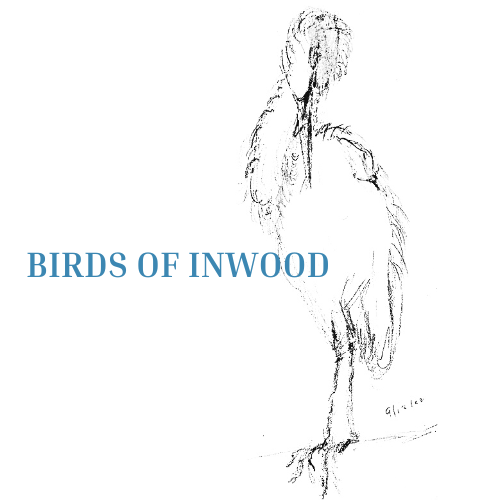
Image: Drawing of a Red-tailed Hawk in a tulip tree in Inwood Hill Park by author. Watersoluble graphite on mixed media paper. 2024.

The trees bloom in April, May, and June, attracting a variety of birds. In winter, the seed heads remain on the trees, but in windy weather, the seeds encased in elongated samaras often come twirling down to the ground. These helicopter seeds are rich in carbohydrates and protein. Cardinals, finches, juncos, and sparrows will rush to eat them. In the winter forest, a good place to find birds is at the base of a tulip tree.

Inwood was once home to the Great Tulip Tree, an enormous 165-foot tree with a 20-foot girth. After increased distress in the early 1930s and unsuccessful surgeries, the tree succumbed to a storm later in the decade. The commemorative Shorakkopoch Rock plaque at the edge of the athletic fields and near the northern entrance to the Clove marks the spot where, according to legend, Peter Minuit bought the island of Manhattan for 60 guilders and where the old tree once stood. (Read more on the website for NYC’s Department of Records and Information Services.)
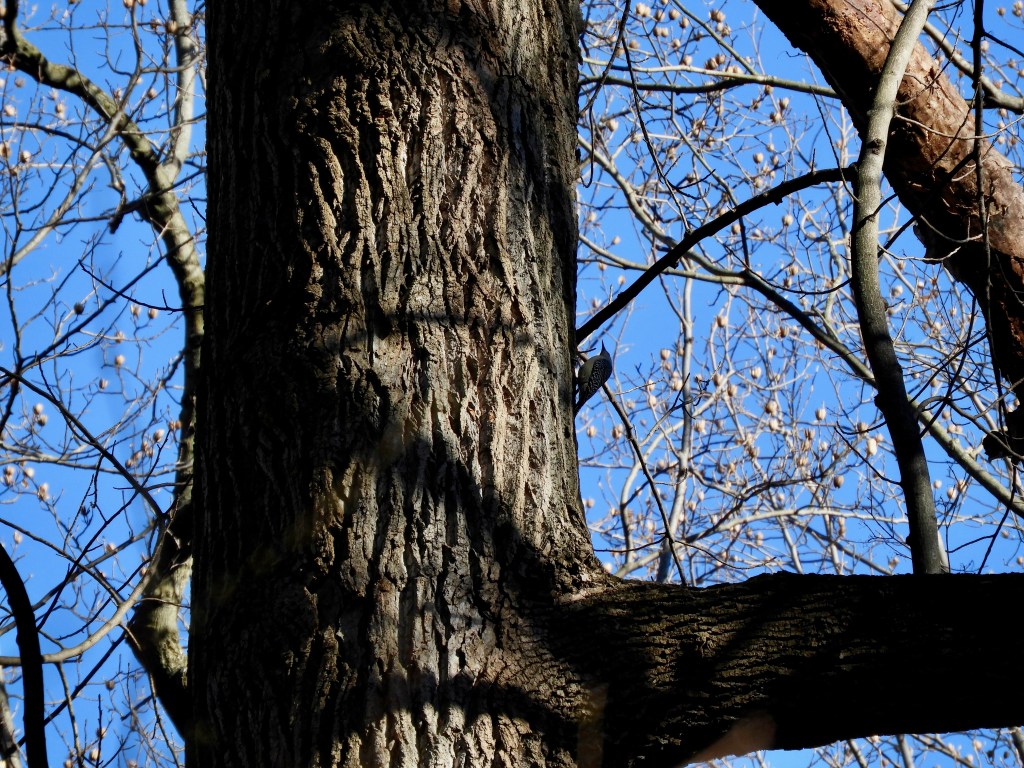
The tulip trees featured in many of these pictures are just yards away from that site.*

I often see pictures of beautiful birds just being beautiful and fascinating, but it’s worthwhile to take a minute contemplating what birds need in order to thrive. In this case, consider the role of the beautiful tulip tree. Beyond the tree, birds need a healthy ecosystem, a stable climate, adequate supplies of water, food, healthy air, and a peaceful environment. You know, just like us.
Cover image: A Red-tailed Hawk in a tulip tree. February 5, 2024.
* Resource: The New York Tree Map provides a valuable tool for learning about the trees maintained by the NYC Parks Department.
Recent posts
- Herons in Trees: Watching and Waiting at High Tide
- A Green Heron Joins the Other Dinosaurs, and the Pursuit of the Big Picture
- Sporting Colors: The 2026 Baltimore Orioles Season in Inwood Hill Park
- Field Notes from the 2026 Cedar Waxwing Gathering in Isham Park
- Birds in the Garden of Eden: A Field Trip to Untermyer Park and Gardens in Yonkers, New York
Sightings
Between posts, look for the monthly Sightings page for new pictures. See the February 2024 page. A Great Horned Owl and an Eastern Screech-Owl have been active in the forest this month.


Comments welcome!