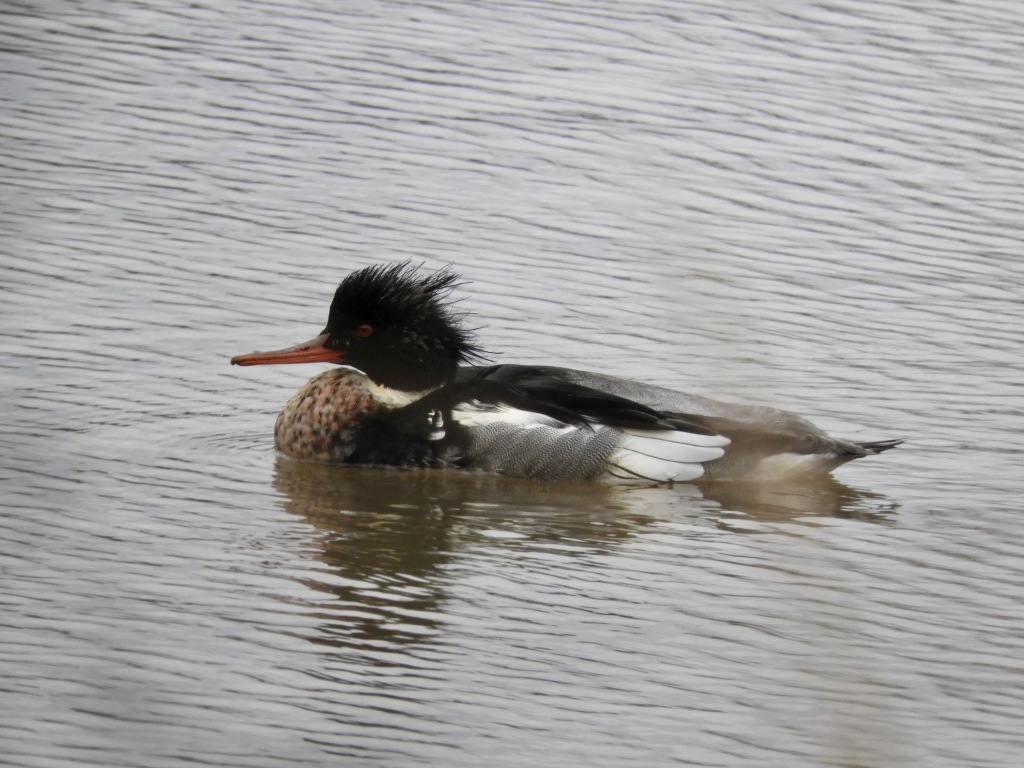
On the morning of Sunday, January 14, 2024, a male Red-breasted Merganser was floating along the banks of the Salt Marsh and trying to get some rest. Nearby was a group of Mallards that occasionally quacked.

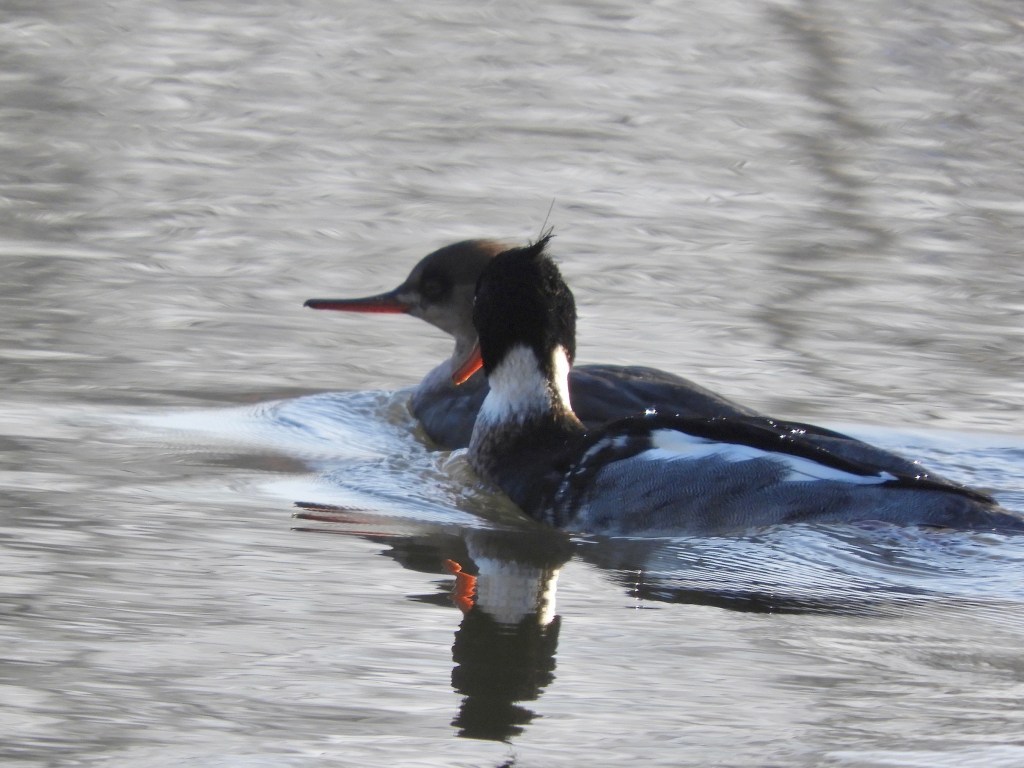
The Merganser is usually seen with its partner, often in the nearby Muscota Marsh, but this morning it was by itself, except for the Mallards.
I was thinking how cold the water must be for the merganser, but this is a duck accustomed to much colder climates. Its range includes places such as Alaska, Labrador, and Maine, and it winters along the coast. It makes sense that this one probably comes from Maine and has flown down to fish in the salty waters of our local Salt Marsh.

This Red-breasted Merganser has a long red bill that makes fishing efficient in its long water dives. Also called a “sawbill,” the duck has small serrated tooth-like projections on its bill that make catching fish easier. They need to eat a lot, something in the range of 15-20 fish a day. (Source: All About Birds guide on the Red-breasted Merganser from the Cornell Lab)

Part of the fun when following mergansers is that they will disappear under water for a long time and then pop up somewhere far away. These dives make them rather elusive for observation, so it was a rare treat on Sunday to encounter a sleepy merganser close to the shore. Another fascinating fact about these birds is that they are among the fastest fliers, clocking speeds around 81 miles an hour (see Cornell source on their life history).
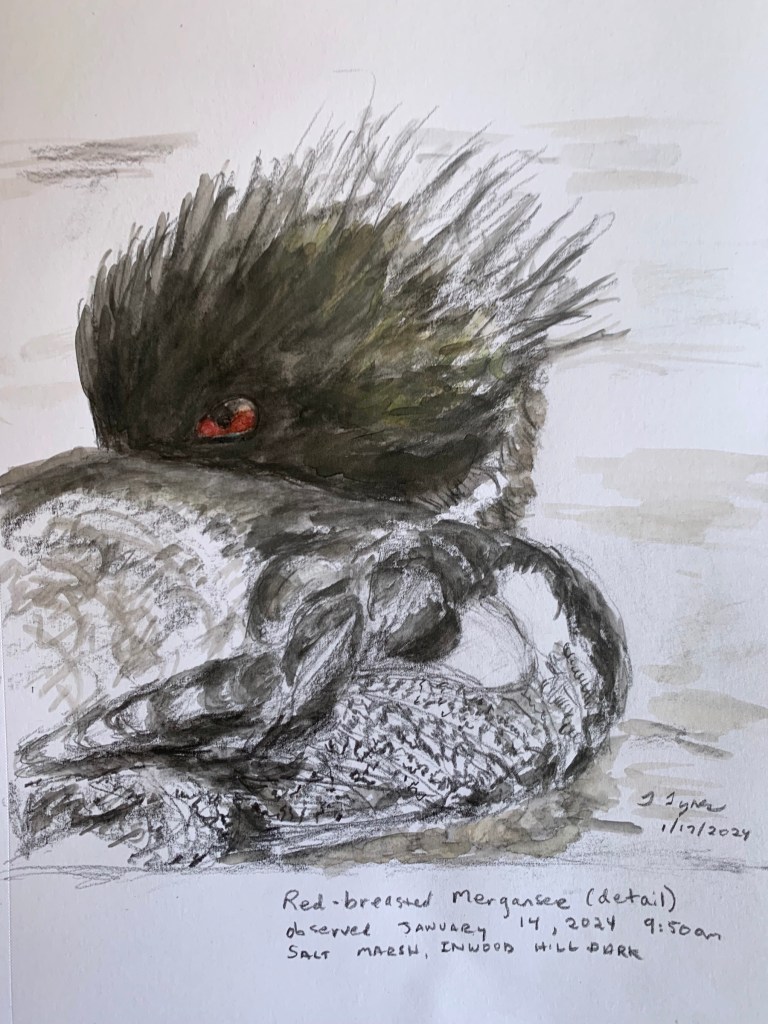
Water-soluble graphite and watercolor in a 7″ x 10″ inch Canson mixed-media sketchbook.
This is a fancy-looking duck with remarkable features, patterns, and colors. It sports a reddish brown breast, a white neck, and a raggedy crest on top of its deep green head. Look at those red eyes! Its main body feathers are startlingly black and white, with many patterned in an OpArt effect of wavy black-and-white striped swirls. I was immediately drawn to exploring it more in my sketchbook.
Cover: Red-breasted Merganser in the Salt Marsh, Inwood Hill Park. January 14, 2024.
Recent posts
- A Green Heron Joins the Other Dinosaurs, and the Pursuit of the Big Picture
 A lively Green Heron has been drawing attention this summer at the Salt Marsh in Inwood Hill Park. While not uncommon for late summer, this member of the heron family stands out among the Great Egrets, Great Blue Herons, and Black-crowned Night Herons. For one, the Green Heron is of slighter skeletal build compared to… Read more: A Green Heron Joins the Other Dinosaurs, and the Pursuit of the Big Picture
 - Sporting Colors: The 2026 Baltimore Orioles Season in Inwood Hill Park
 Several Baltimore Orioles made their way back to the high trees of Inwood Hill Park this year. They’ve been building and attending nests at the edges of the park. The female builds the nest over the course of the week, while the male goes out on foraging errands. The orioles usually stake out the same… Read more: Sporting Colors: The 2026 Baltimore Orioles Season in Inwood Hill Park
 - Field Notes from the 2026 Cedar Waxwing Gathering in Isham Park
 Dozens of flocks of colorful Cedar Waxwings have arrived in Isham Park in Northern Manhattan for their annual feasting of the Juneberry trees (Amelanchier is the scientific name, or serviceberry). The festive occasion takes place during late May and early June and lasts as long as the bright red berries are consumed. While Cedar Waxwings… Read more: Field Notes from the 2026 Cedar Waxwing Gathering in Isham Park
 - Birds in the Garden of Eden: A Field Trip to Untermyer Park and Gardens in Yonkers, New York
 At Untermyer Park and Gardens in Yonkers, NY, on May 18, I didn’t see many birds out of the ordinary. I was so taken in by the dramatic vistas of the park and garden that I may have overlooked them. Tens of thousands of birds migrate north of New York City each spring and… Read more: Birds in the Garden of Eden: A Field Trip to Untermyer Park and Gardens in Yonkers, New York
 - An Evening Walk with a Great Egret, and Spring Migration Report
 On an early evening walk on May 11, I came across a Great Egret foraging near high tide at the Salt Marsh in Inwood Hill Park. I usually take my walks in the early morning, and the egret usually forages near times of low tide, so this was new for both of us. The Great… Read more: An Evening Walk with a Great Egret, and Spring Migration Report
Support Birds of Inwood

Birds of Inwood is committed to hyper-local bird observation and conservation. If you would like to support Birds of Inwood, please consider making a donation. Payments are made through Stripe Climate. Many thanks.
Make a one-time donation
Choose an amount
Or enter a custom amount
Your contribution is appreciated.
 Birds of Inwood
Comments welcome!