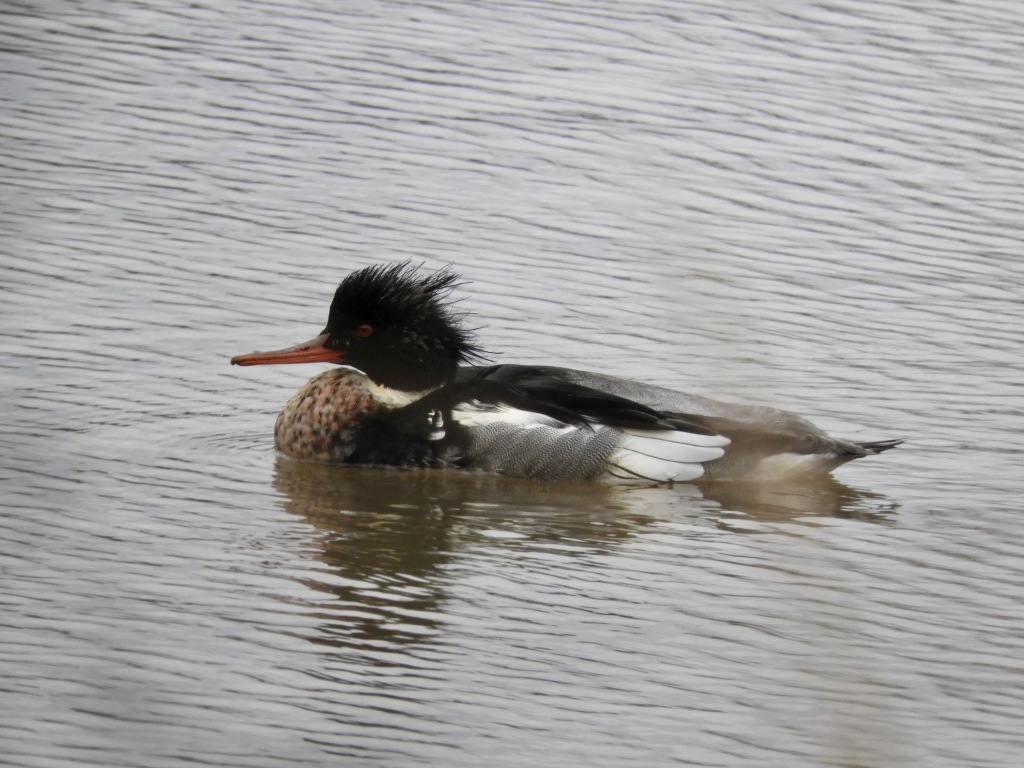
On the morning of Sunday, January 14, 2024, a male Red-breasted Merganser was floating along the banks of the Salt Marsh and trying to get some rest. Nearby was a group of Mallards that occasionally quacked.

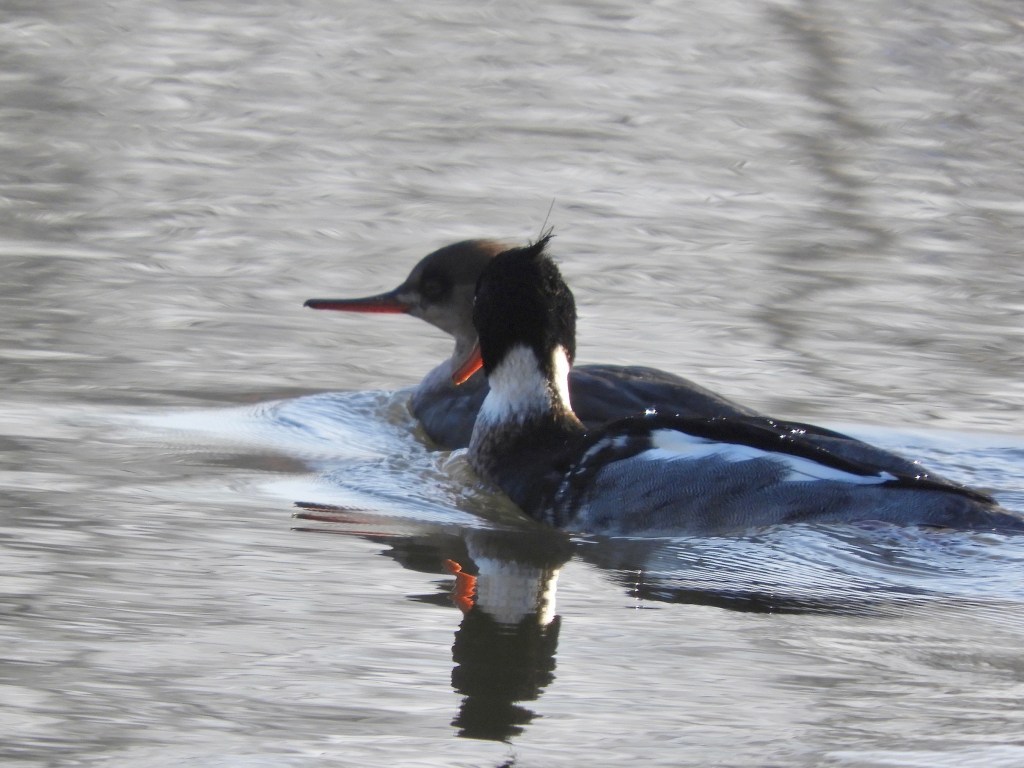
The Merganser is usually seen with its partner, often in the nearby Muscota Marsh, but this morning it was by itself, except for the Mallards.
I was thinking how cold the water must be for the merganser, but this is a duck accustomed to much colder climates. Its range includes places such as Alaska, Labrador, and Maine, and it winters along the coast. It makes sense that this one probably comes from Maine and has flown down to fish in the salty waters of our local Salt Marsh.

This Red-breasted Merganser has a long red bill that makes fishing efficient in its long water dives. Also called a “sawbill,” the duck has small serrated tooth-like projections on its bill that make catching fish easier. They need to eat a lot, something in the range of 15-20 fish a day. (Source: All About Birds guide on the Red-breasted Merganser from the Cornell Lab)

Part of the fun when following mergansers is that they will disappear under water for a long time and then pop up somewhere far away. These dives make them rather elusive for observation, so it was a rare treat on Sunday to encounter a sleepy merganser close to the shore. Another fascinating fact about these birds is that they are among the fastest fliers, clocking speeds around 81 miles an hour (see Cornell source on their life history).
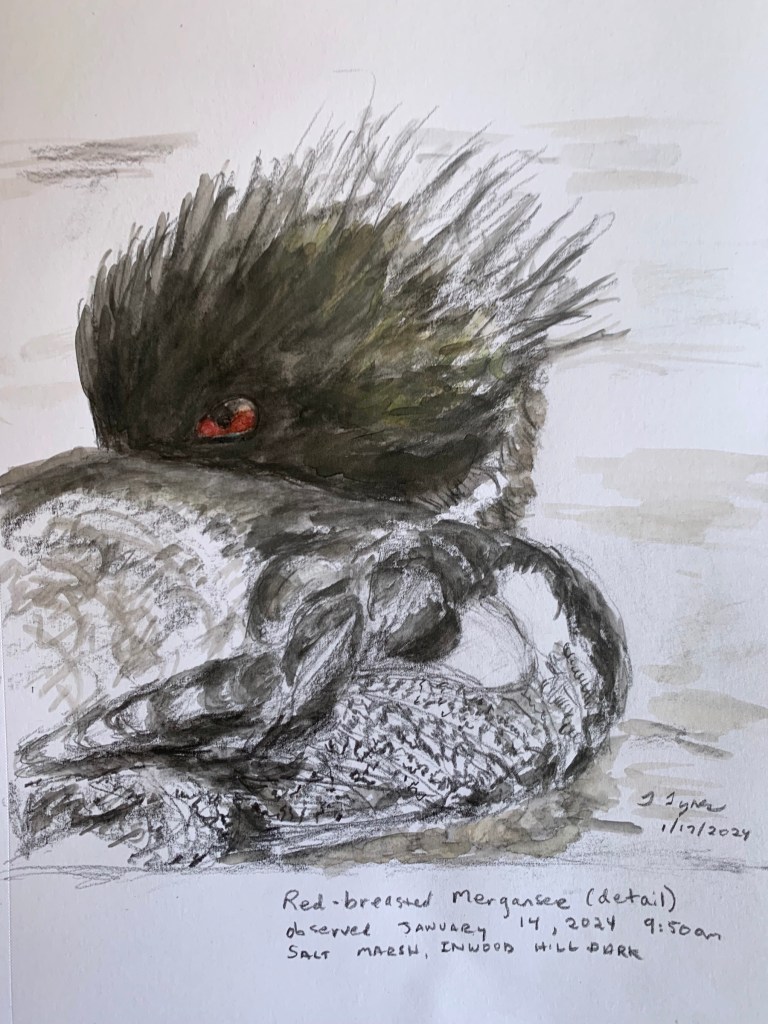
Water-soluble graphite and watercolor in a 7″ x 10″ inch Canson mixed-media sketchbook.
This is a fancy-looking duck with remarkable features, patterns, and colors. It sports a reddish brown breast, a white neck, and a raggedy crest on top of its deep green head. Look at those red eyes! Its main body feathers are startlingly black and white, with many patterned in an OpArt effect of wavy black-and-white striped swirls. I was immediately drawn to exploring it more in my sketchbook.
Cover: Red-breasted Merganser in the Salt Marsh, Inwood Hill Park. January 14, 2024.
Recent posts
- Northern Mockingbird – The Bossiest Singer in the Park
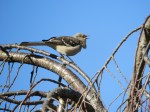 Northern Mockingbirds are famous for their expressive and varied songs, often mimicking other birds. All this month, whenever I have had occasion to walk in Inwood Hill Park or Sherman Creek Park, I’ve come across a loud mockingbird singing its heart out.
 - An Early Spring Preview of the Birds of Inwood
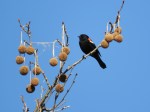 A burst of spring weather and unseasonably warm days brought a variety of birds to Inwood Hill Park in Northern Manhattan this week. The three days in early March— March 9 through March 11— felt like a gift, especially after a long winter of cold temperatures and abundant snow. Many New Yorkers talked about how… Read more: An Early Spring Preview of the Birds of Inwood
 - The Snowiest of Snows, and a Bald Eagle Appears
 On Monday, February 23, the snow fell across New York City in steady downfalls over many hours, embedded in a winter storm that arrived late afternoon on Sunday and continued well into the afternoon. By the end, Central Park experienced one of the largest snowstorms in the city’s history. * Up here in Northern Manhattan,… Read more: The Snowiest of Snows, and a Bald Eagle Appears
 - Blizzard Warning: A Great Blue Heron Hunkers Down, and Other Stories of the Birds of Inwood in a Cold and Snowy Month
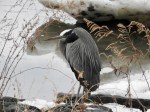 Northern Cardinals have resumed singing their song of spring this past week, so you would never know that NYC and parts of the Tri-State area are currently under a blizzard warning. As I write, the temperatures are mild, and the sky is blue. The blizzard warning is the first such weather alert issued for NYC… Read more: Blizzard Warning: A Great Blue Heron Hunkers Down, and Other Stories of the Birds of Inwood in a Cold and Snowy Month
 - A Red-shouldered Hawk for Valentine’s Day
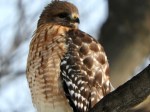 I fell in love this morning on my walk over to the Hudson River. I was walking very slowly on the sloped path leading up to the Henry Hudson Bridge. The path was a little icy, still covered with recent snow, and I was careful with every step. My intention was to see the Bald… Read more: A Red-shouldered Hawk for Valentine’s Day
Support Birds of Inwood

Birds of Inwood is committed to hyper-local bird observation and conservation. If you would like to support Birds of Inwood, please consider making a donation. Payments are made through Stripe Climate. Many thanks.
Make a one-time donation
Choose an amount
Or enter a custom amount
Your contribution is appreciated.
Donate Birds of Inwood
Comments welcome!