(UPDATED June 11, 2023) A pair of Ospreys has been active at the Salt Marsh and Muscota Marsh in recent days, and there’s some indication that they may attempt to stay. On the late afternoons of May 29 and 30, the Ospreys were flying over the marshes and diving feet first into the waters to fish, all perfectly normal Osprey behavior, but they were also delivering sticks to the top platforms of the light towers over Columbia University’s football stadium.

This is a surprise in many ways. Just as spring migration was wrapping up, as birdwatchers strained to follow small five-inch birds on the tops of trees in thick foliage, two birds of prey with wingspans of six feet showed up at the marshes. In recent years, an Osprey or two came to visit at the end of the summer shortly around Labor Day. In September of 2021, I observed an adult Osprey and juvenile at the marsh. Last year I saw one Osprey arrive around Labor Day that stuck around for a few weeks to fish. (pictures on the Osprey page.)

An Osprey on Memorial Day is a surprise, at least to me. The two Ospreys who flew around the marshes on Monday also didn’t seem to mind that several hundred people happened to be in the park enjoying holiday picnics. Not many people seemed to even notice them, but I am grateful for the one strolling couple who stopped to chat and to point out that one Osprey flew right over them and was taking a stick to a tower.


The bigger surprise is the activity of two Ospreys eyeing the platforms of the stadium towers for possible nesting sights. (see UPDATE on another scenario.) Ospreys usually select platforms such as this, but this location would be new. At Cornell University in Ithaca, the well-known nesting site for Red-tailed Hawks is almost exactly this sort of nesting configuration. (See Cornell’s webcam for Red-tailed Hawks.) If the actions of the Columbia University Ospreys continue, we may be looking at another Ivy League nest, this time in Northern Manhattan for “fish hawks.” Yet, I may be getting ahead of myself. For now, I observed one Osprey landing on three of the four towers, with the southeast tower most active with both the Ospreys and the most nesting material.

It just so happens that Columbia University is putting the finishing touches on their new tennis center nearby. The center, located on the riverfront north of the university’s boathouse, will feature indoor courts, six rooftop courts, and an extended path from the landscaped Muscota Marsh, a public green space. I am imagining what it would be like to play a competitive tennis match with Ospreys flying overhead.

The marshes of Inwood already attract big birds. The Great Egret, a resident favorite is here, and Great Blue Herons are now making more frequent appearances. When I saw the Ospreys on Tuesday, I saw a Bald Eagle up higher in the sky. Turkey Vultures are around, and so, too, are Red-tailed Hawks.

The Ospreys personally surprised me, because I had assumed I had to wait all summer until I saw them again. I had planned to write a summary of spring migration today. There’s a lesson here. Or, this could be just the first chapter of a longer story.
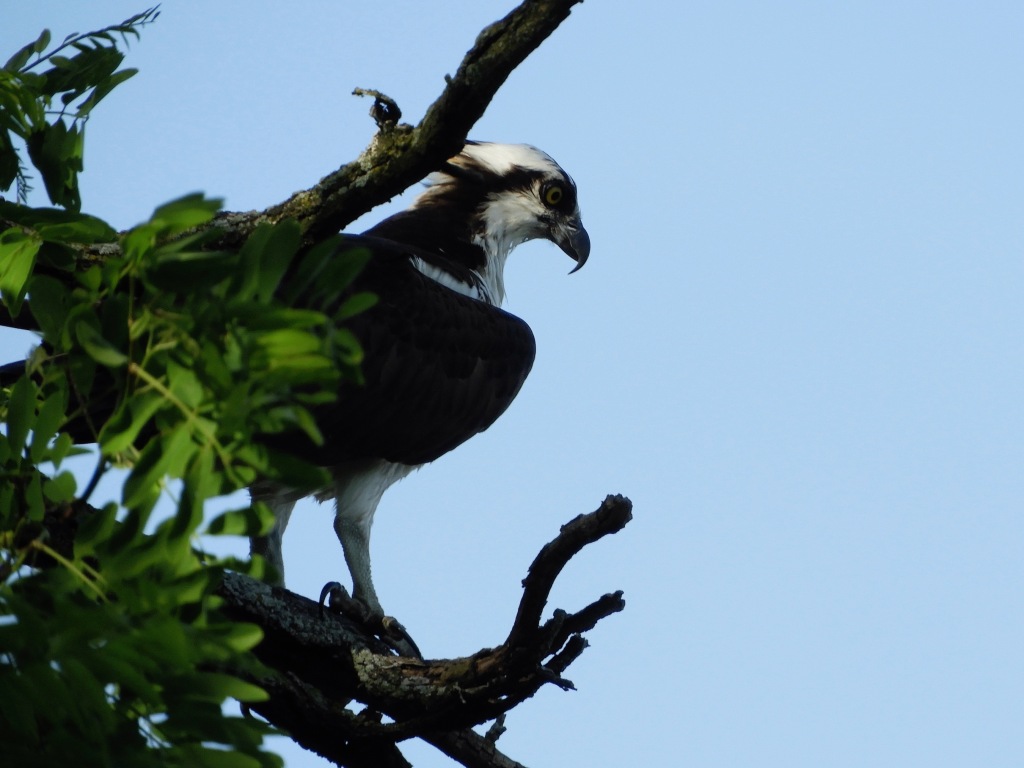
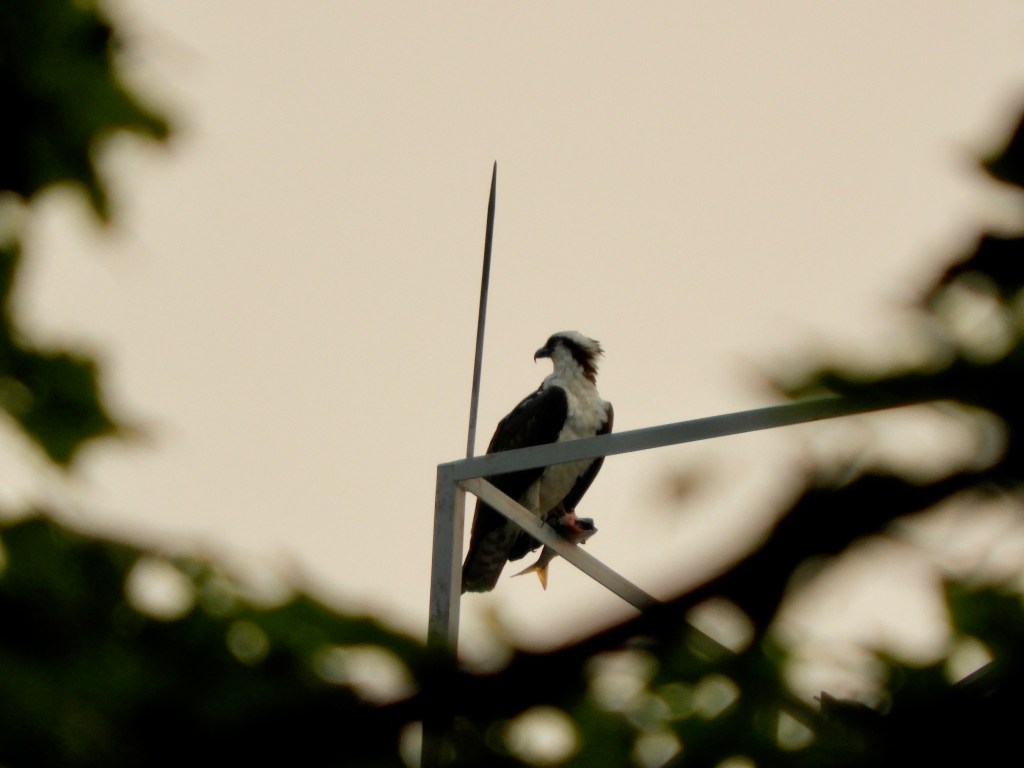
Cover image: One of the Ospreys flew into a tree on the west bank of Muscota Marsh to get a better view of the fish below. May 30, 2023.
Updates
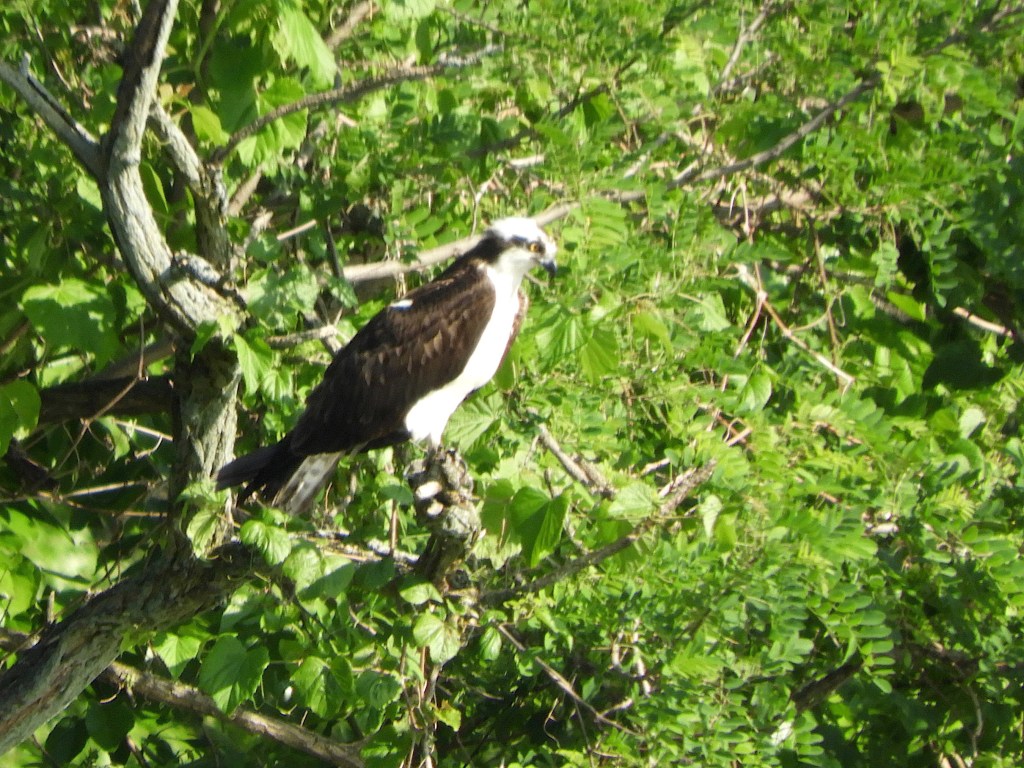
On June 1 at 8 am, an Osprey flew into Muscota Marsh and headed for the SE light tower above the stadium. It circled back to this tree on west side of marsh.
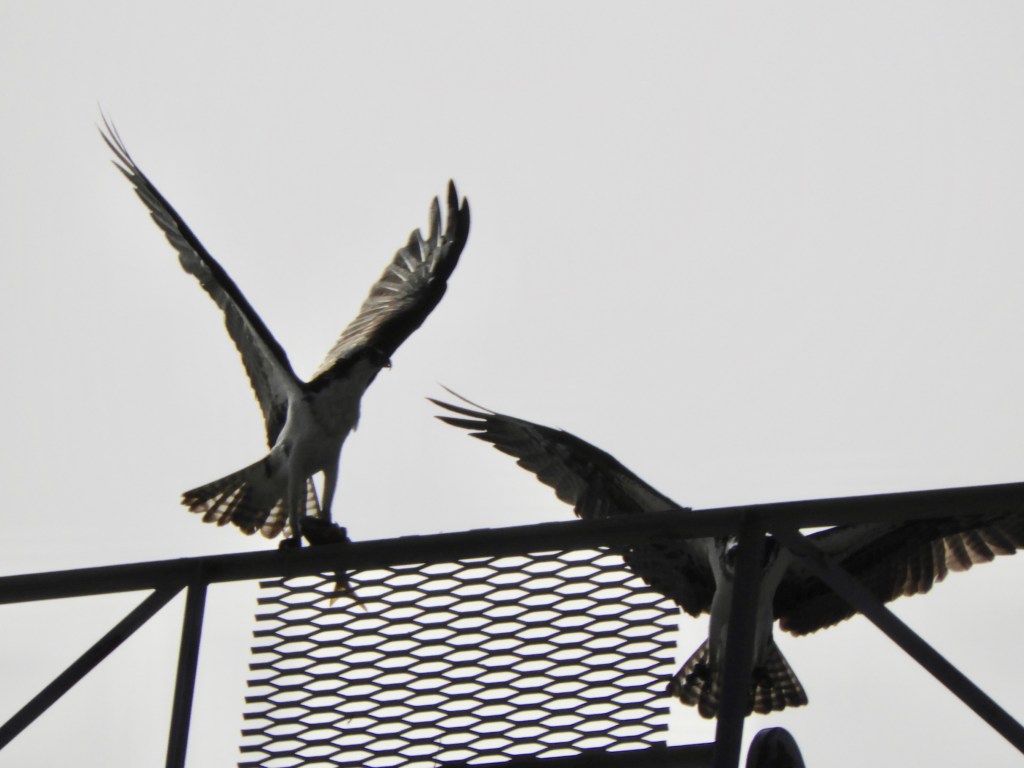
On June 4 at 9:24 am, I observed these two Ospreys on the NW tower over the stadium. As I watched, I saw another Osprey (not shown). THREE Ospreys! Could this be two adults and a juvenile? Then a new scenario arrises. This may not be the story of two Ospreys searching for a nesting site. The adults may be training a young Osprey how to fish and become more independent. (UPDATE: No. I don’t think so. As of June 11, 2023. There remains only the pair. Read on.)
On June 6, the skies were hazy with smoke drifting in from wildfires in Ottawa, Canada. I observed one Osprey carrying a half-eaten fish. It moved from one tower to another. All the while, it was looking at the skies.

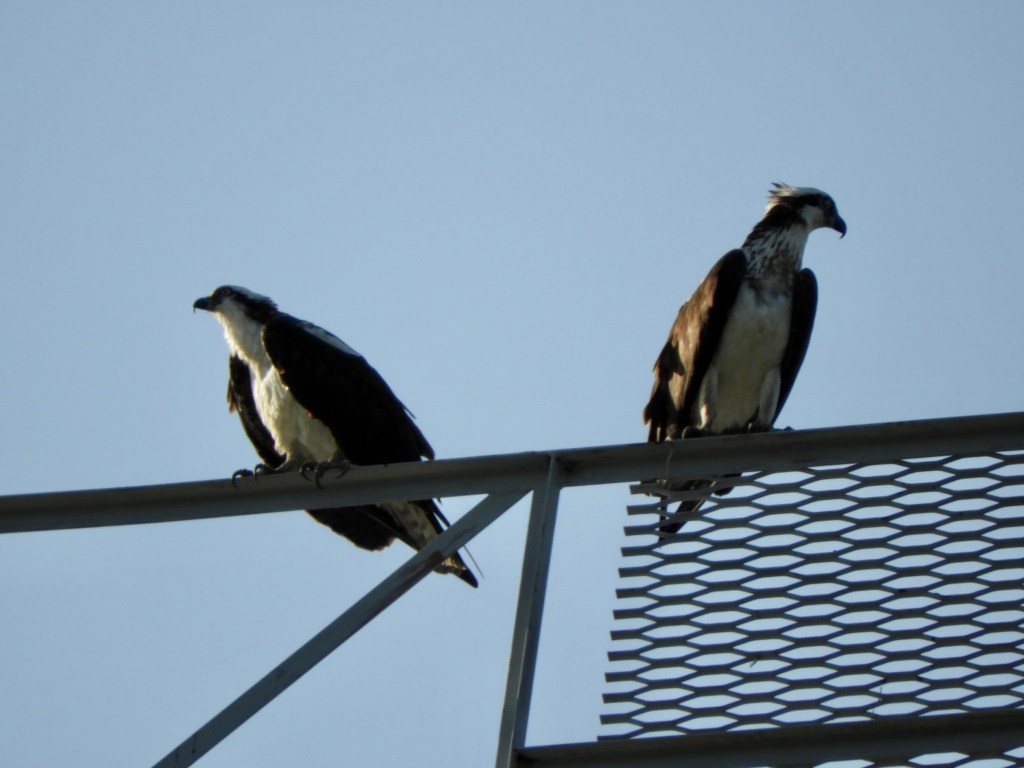
June 11, 2023. After the skies cleared from the smoke from the wildfires in Canada, I returned to the stadium towers. A clearer scenario unfolded as I observed the pair mating. This came as a big surprise, at least with my fortunate timing.
The male Osprey has a white breast, while the female has darker feathers around the neck. The male also continues to deliver sticks to the southwest stadium tower where I observed this behavior.

Recent posts
- A Green Heron Joins the Other Dinosaurs, and the Pursuit of the Big Picture
- Sporting Colors: The 2026 Baltimore Orioles Season in Inwood Hill Park
- Field Notes from the 2026 Cedar Waxwing Gathering in Isham Park
- Birds in the Garden of Eden: A Field Trip to Untermyer Park and Gardens in Yonkers, New York
- An Evening Walk with a Great Egret, and Spring Migration Report
 Birds of Inwood
Comments welcome!