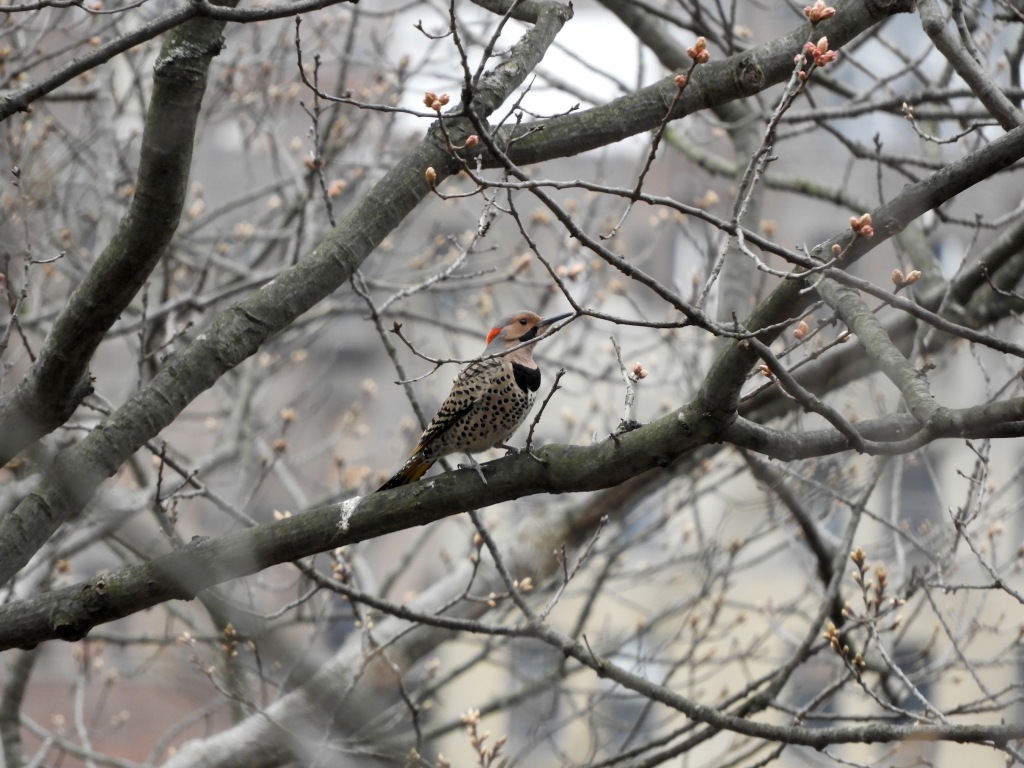
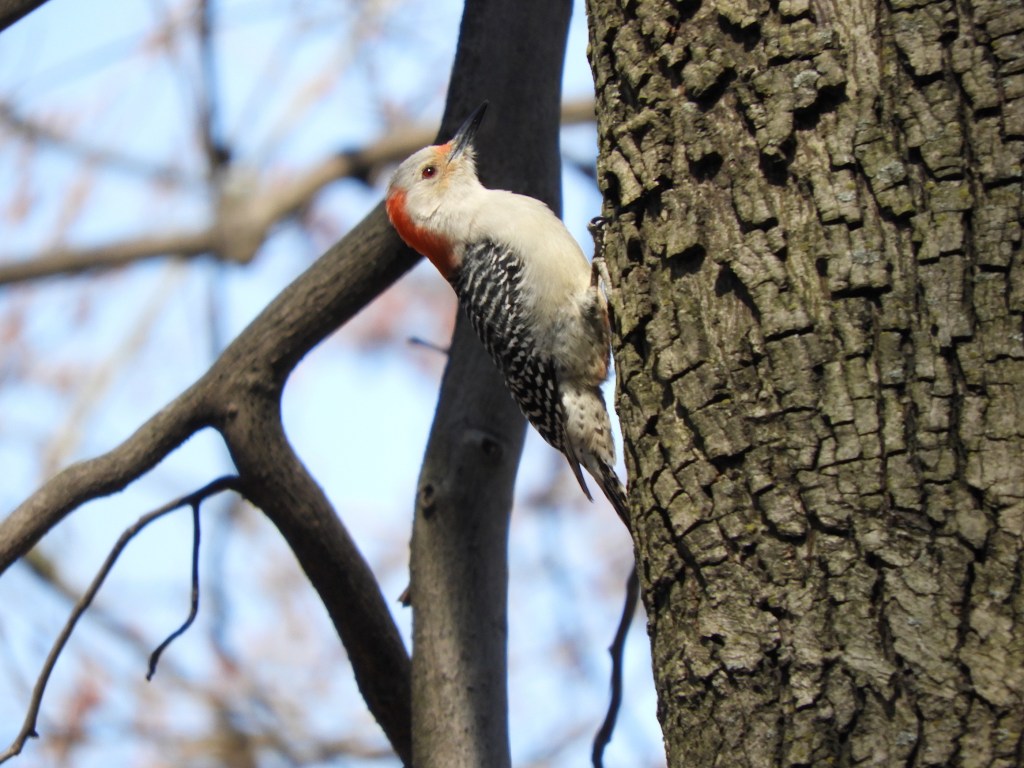
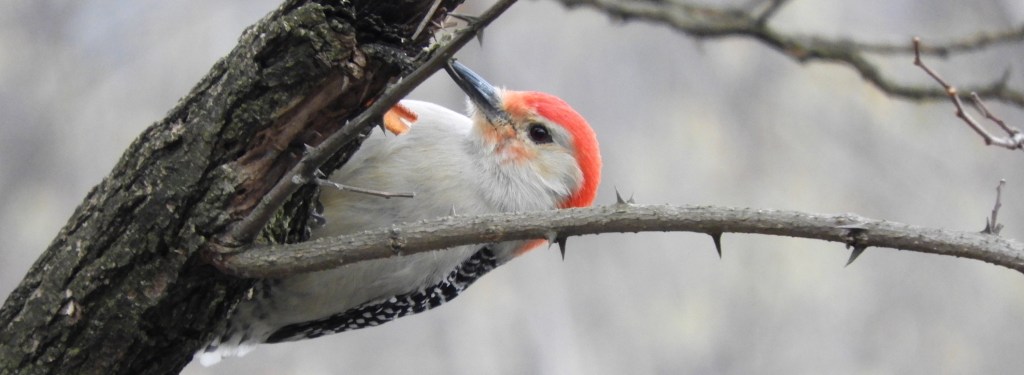
Woodpeckers are commonly seen and heard all year round throughout Inwood Hill Park, and now the migratory Northern Flickers have joined them. Downy Woodpeckers are common here, and so are Red-bellied Woodpeckers. A Hairy Woodpecker and a Yellow-bellied Sapsucker may sometimes be seen. A Pileated Woodpecker, which I have yet to see, is the Holy Grail. (See update from April 21, 2023).

Naturally, an old growth forest would attract these birds, for they go pecking at the tree bark for insects, acorns, nuts, and seeds. I know one friend who regularly feeds peanuts to the squirrels in the park, and a Red-bellied Woodpecker usually shows up.
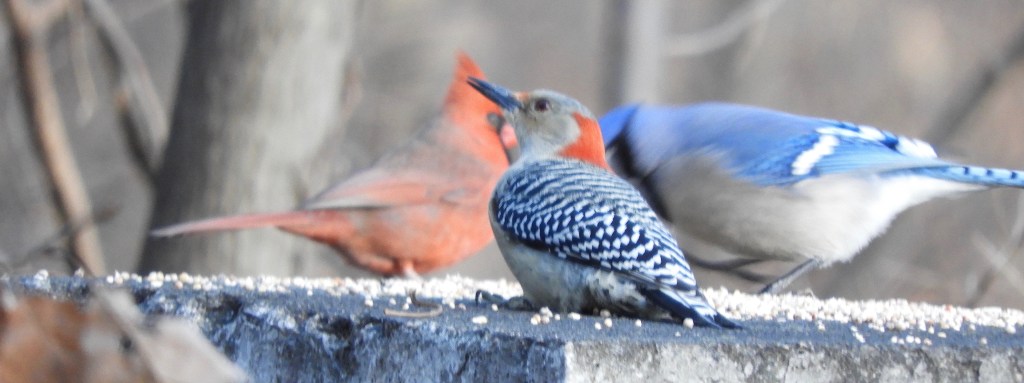
Most of the woodpeckers make loud sounds when banging their beaks on the trees, and sometimes the effect is quite loud. Their noise is amplified in the forest, especially the section adjacent to the athletic fields near the Salt Marsh.

The athletic fields form a semicircle next to the water, and tall trees line the park path around the fields. Woodpeckers are so common here that I’ve come to call this path “Woodpecker Way.” It was here, in this promenade, that I first heard a Northern Flicker return to the park at the end of March.
There is no mistaking the sound of the Northern Flicker. When they are not drumming on something, they let out a loud and repetitive, almost hysterical cry. They can be fiercely territorial. I still remember coming across one of their fights deep in the forest a few years ago.

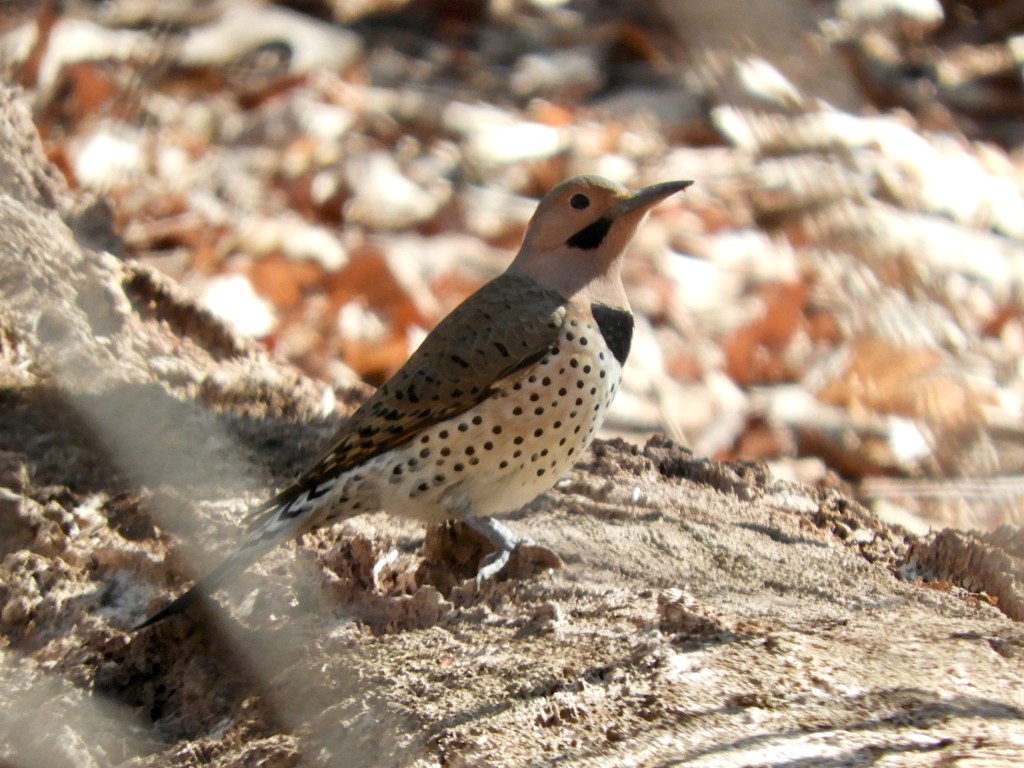
A large woodpecker, the Northern Flicker is fascinating to observe. While largely brown, they have a red nape and a black bib, both rather geometrically defined. For these yellow-shafted Eastern flickers, the male birds have a black whisker and the females none. In flight, you may see a prominent white patch on their rump as well as a “flicker” of yellow. Northern Flickers actually prefer the ground for feeding, looking mainly for ants.

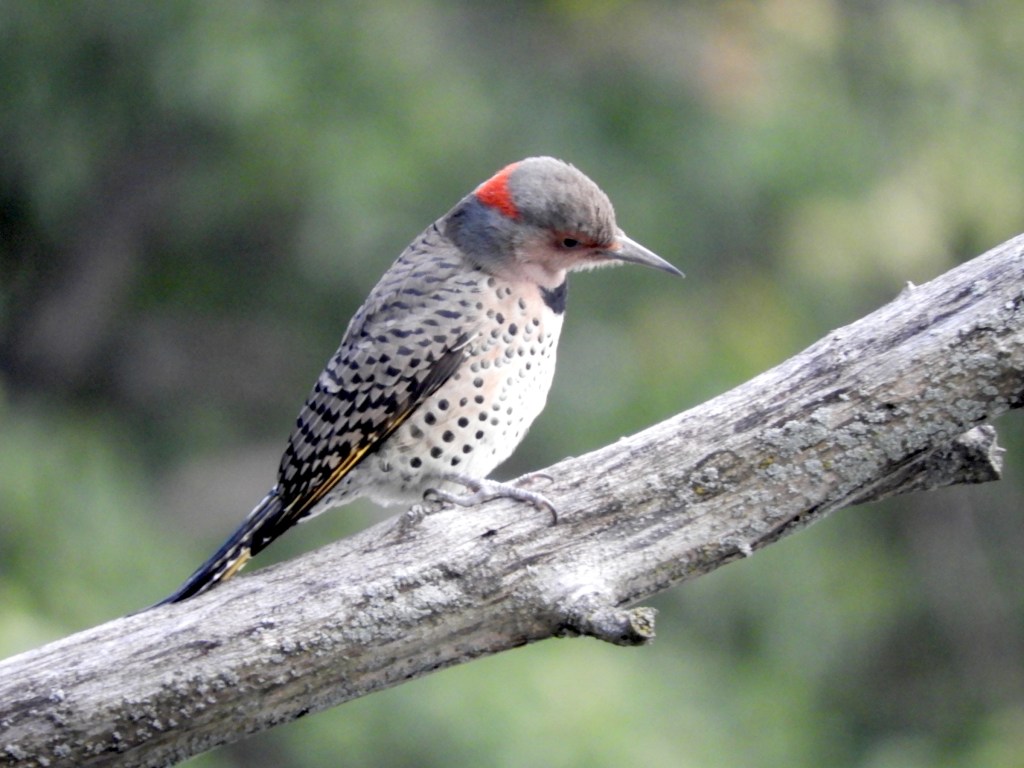

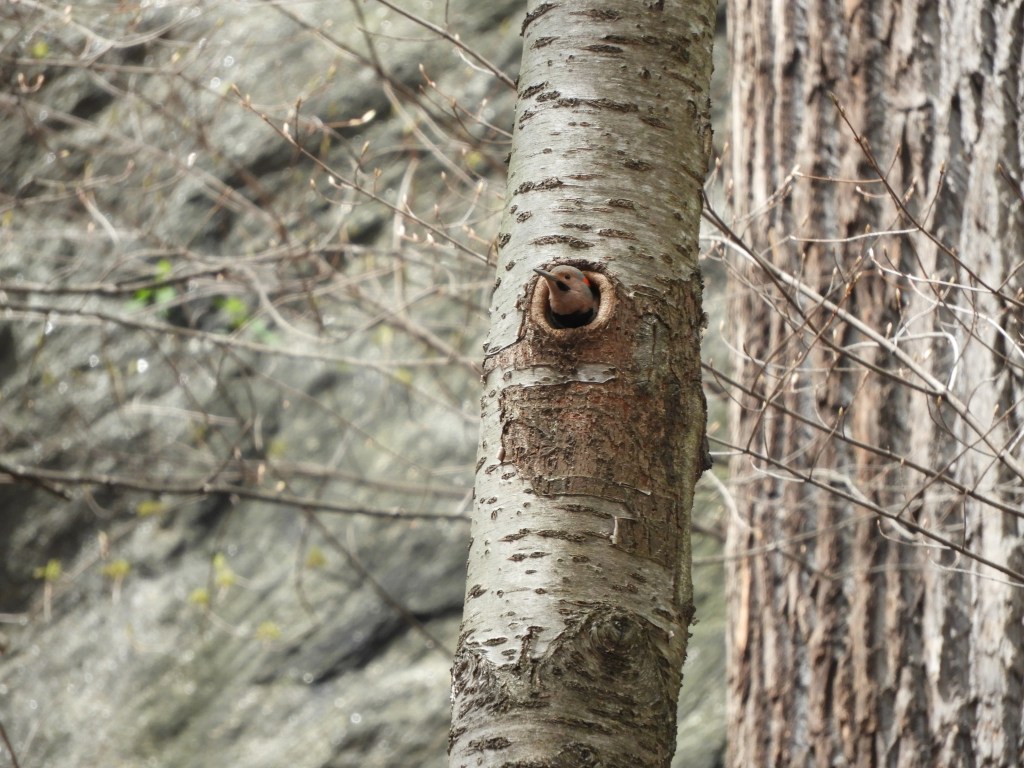
A Woodpecker Gallery

October 23, 2022
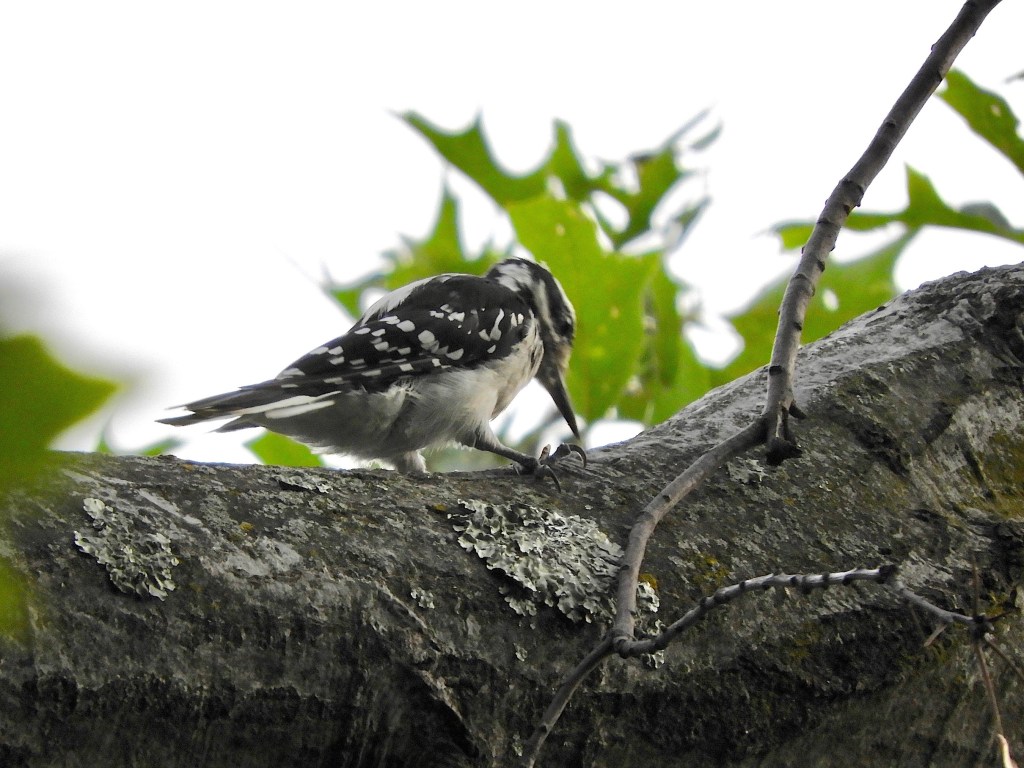
July 29, 2022
March 20, 2023

March 5, 2023

March 20, 2023
March 29, 2023
Recent posts
- Northern Mockingbird – The Bossiest Singer in the Park
 Northern Mockingbirds are famous for their expressive and varied songs, often mimicking other birds. All this month, whenever I have had occasion to walk in Inwood Hill Park or Sherman Creek Park, I’ve come across a loud mockingbird singing its heart out.
 - An Early Spring Preview of the Birds of Inwood
 A burst of spring weather and unseasonably warm days brought a variety of birds to Inwood Hill Park in Northern Manhattan this week. The three days in early March— March 9 through March 11— felt like a gift, especially after a long winter of cold temperatures and abundant snow. Many New Yorkers talked about how… Read more: An Early Spring Preview of the Birds of Inwood
 - The Snowiest of Snows, and a Bald Eagle Appears
 On Monday, February 23, the snow fell across New York City in steady downfalls over many hours, embedded in a winter storm that arrived late afternoon on Sunday and continued well into the afternoon. By the end, Central Park experienced one of the largest snowstorms in the city’s history. * Up here in Northern Manhattan,… Read more: The Snowiest of Snows, and a Bald Eagle Appears
 - Blizzard Warning: A Great Blue Heron Hunkers Down, and Other Stories of the Birds of Inwood in a Cold and Snowy Month
 Northern Cardinals have resumed singing their song of spring this past week, so you would never know that NYC and parts of the Tri-State area are currently under a blizzard warning. As I write, the temperatures are mild, and the sky is blue. The blizzard warning is the first such weather alert issued for NYC… Read more: Blizzard Warning: A Great Blue Heron Hunkers Down, and Other Stories of the Birds of Inwood in a Cold and Snowy Month
 - A Red-shouldered Hawk for Valentine’s Day
 I fell in love this morning on my walk over to the Hudson River. I was walking very slowly on the sloped path leading up to the Henry Hudson Bridge. The path was a little icy, still covered with recent snow, and I was careful with every step. My intention was to see the Bald… Read more: A Red-shouldered Hawk for Valentine’s Day
 Birds of Inwood
Comments welcome!