For a bird I’ve seen infrequently, the Black-and-white Warbler has played an oversized role in my personal life over the last decade.
When I moved to the Inwood neighborhood of Northern Manhattan in 2014, I wasn’t familiar with the area. I just found it to be wild. I had previously lived in Greenwich Village, and the contrast between the streets downtown and the hilly landscapes of Northern Manhattan seemed like night and day. In those early months of uptown living, I would take a walk with my camera through the paths of Inwood Hill Park, and I saw birds I had never seen before. One was a Black-and-white Warbler. I found them scrambling up and down and around trees, their characteristic behavior.

Flash forward to the COVID lockdown of spring 2020. Recall that shortly after the lockdown, the then governor advised older people to leave their apartments and walk in nature. There was little else to do, so I headed to the woods. Spring was beautiful then and quiet. I started birding at increased frequency, and I paid attention to the wonders of spring migration. I saw many new birds for me, including a whole flock of Scarlet Tanagers. And I made note of the Black-and-white Warblers.
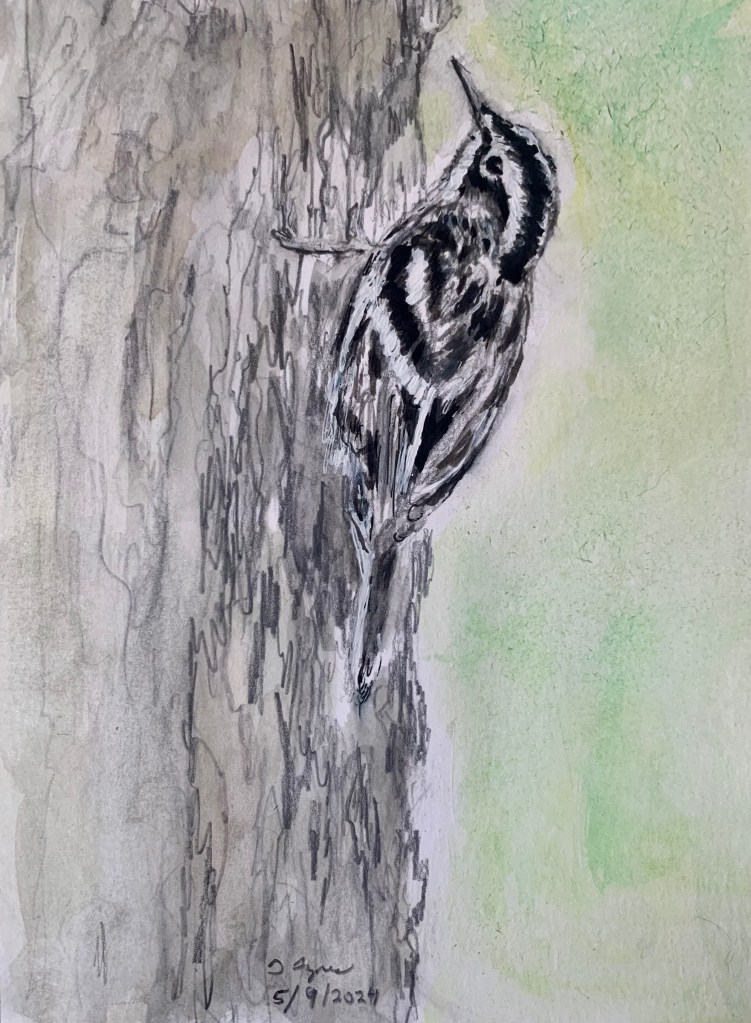
The Black-and-white Warblers are startling to see in their bold op-ed black and white plumage. They have some delicate details, such as a downcurved bill and a relatively short tail. They possess high thin voices with a little squeak. They are the only member of the genus Mniotilta (moss plucking), emphasizing their singularity. Males have been observed to arrive in breeding grounds before the females, and nests are then built hidden in the ground with leaves and moss. Now I worry I will accidentally step on one.

These warblers prefer forests, as that’s where they winter. They are found in the colder months in the woods of Florida, Central America, West Indies, Columbia and Peru. Black-and-white Warblers make a good introduction for birding warblers, as they often appear low on the trunks of the tree.

The current spring migration has already brought a healthy number of Black-and-white Warblers to the park. In the late afternoon of April 30, I saw five or six in trees on the high ridge overlooking the Hudson River. Since then, I have seen more, especially in the morning light on the trees at the top of the W. 207th Street steps. As with most warblers, scaling the heights of the landscape affords the best views.
I don’t know what seeing these recent warblers will ultimately mean to me personally, but as with 2014 and 2020, they are training me to stay aware and present in the current moment.

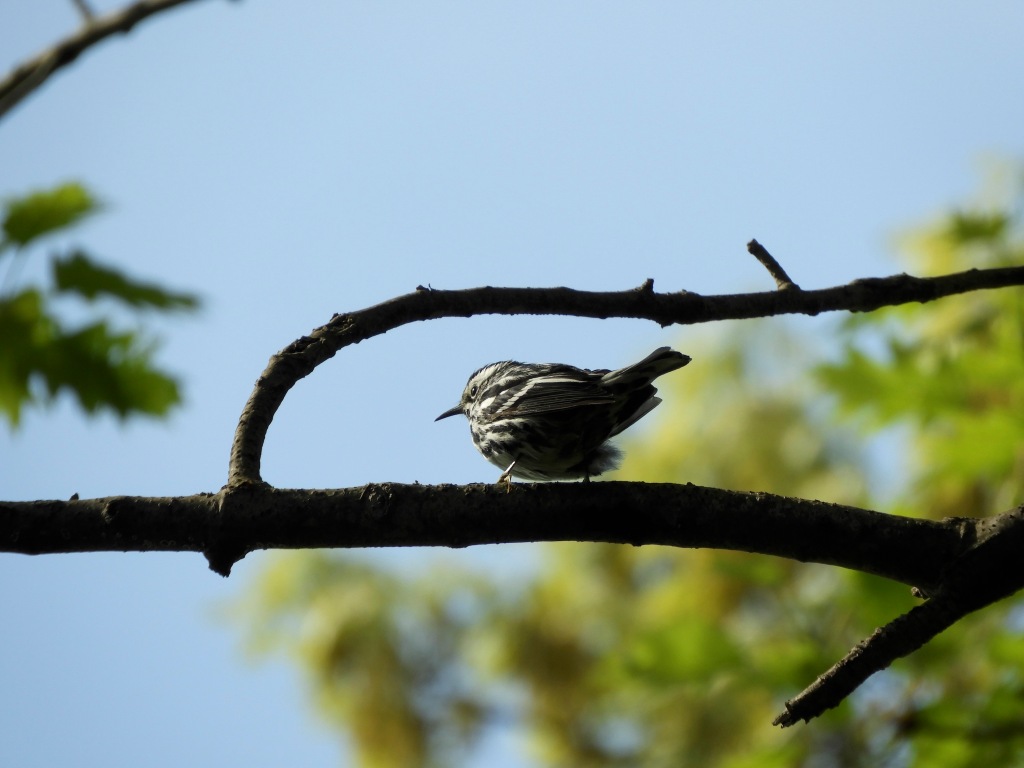
Cover: Black-and-white Warbler looking out over the Hudson River from a high path in Inwood Hill Park. April 30, 2024. 4:51 p.m.
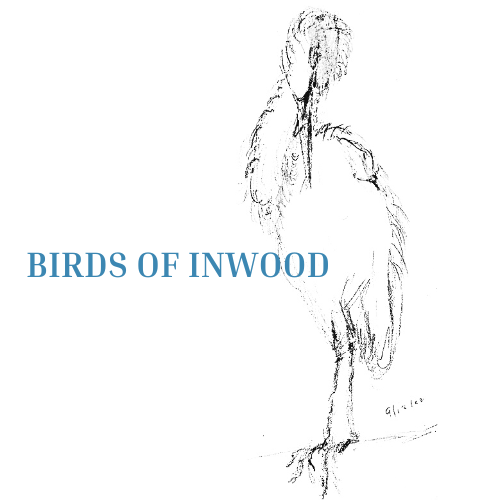
* I based the drawing on a photograph I took in May 2020 and published as an illustration on my blog, Walking Off the Big Apple. The blog post titled “A Walk in the Forest Primeval” (May 18, 2020) muses on the origins of Inwood Hill Park, the pandemic, and the crisis of civilization. Some of that original text has been repurposed here on the home page of Birds of Inwood.
Spring Migration
A few high migration days have brought an abundance of migratory birds to Inwood Hill Park. Fellow local birders have spotted a diversity of warblers. See one of the local ebird lists for Inwood Hill Park. Highlights for me include a Marsh Wren and a few Black-throated Blue Warblers. See the May 2024 Sightings page for pictures.
May 11 is World Migratory Bird Day
The day raises awareness about decline of bird populations worldwide due to climate change and loss of habitat. According to many studies, 1 in 4 birds have vanished in our lifetime.
Birdwatchers will commemorate the day with bird counts, and birdwatching events are planned across NYC in in Staten Island, Jamaica Bay, Bronx Zoo, Randall’s Island, Fort Tryon Park, Governors Island, and other locations. (NYC Audubon event page.)
The theme of this year’s event is insects, a topic important to the Black-and-white Warblers and other migratory birds.
 Birds of Inwood
Comments welcome!