One of my favorite vintage books, The New Field Book of Nature Activities and Hobbies by William Hillcourt, first published in 1950 by G. P. Putnam’s Sons, devotes a chapter to birdwatching. I own the 1970 edition. Hillcourt recommends what to wear – clothes of drab hues in the blue/green/gray range but no white as it scares the birds, and what to bring – a good field guide and field glasses. On the latter, he suggests, “If you have a pair of opera glasses in the house, make use of them in the beginning.” (p. 55) He also urges setting out at daybreak. He writes, “Your best bird-watching time is from early dusk until the sun is four fingers above the horizon.” (P. 59)
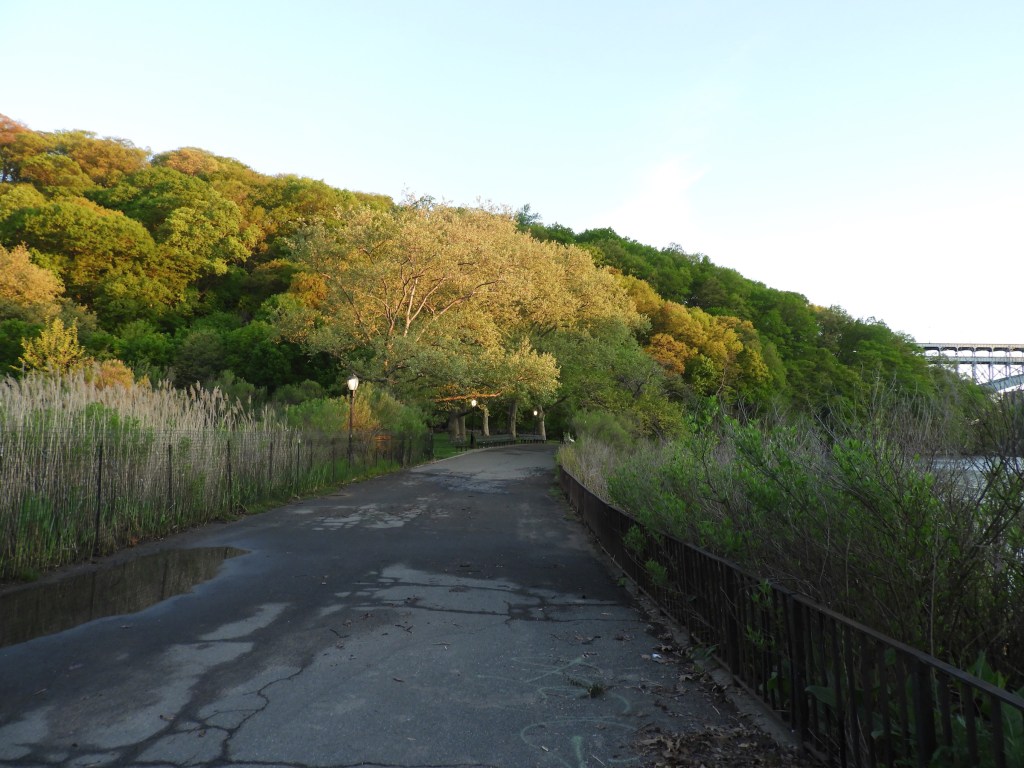
While I would rather save the opera glasses for the actual Met Opera, the “four fingers” rule most often works well. Birds are active and vocalizing at that time. I would also recommend carrying sunglasses and a brimmed hat.
As an early bird by nature, I have no problem with a bird walk at sunrise. Even before daybreak, the period of astronomical twilight already awakens a host of House Sparrows living outside my window as well as a nearby Northern Cardinal and an operatic American Robin.

On the morning of May 7, I drank coffee and checked the Cornell Lab’s BirdCast migration tools (birdcast.info) for the latest pre-dawn happenings in the sky. For New York County, the data indicated upward of 227,000 birds were detected flying through the county in the overnight hours, exceeding by far any previous day totals for this year’s spring migration. It’s warbler time, a series of spring days that bring new arrivals every night and day. It’s exciting. Still, I’ve had enough experience with past migration seasons to not get my hopes up for clearly seeing, much less photographing, tiny colorful birds at the top of the trees.

When setting out on a bird walk, it’s best to embark on an exploration with an open mind. Yes, Cornell’s data showed what birds might typically arrive overnight, but the practice of listening and scanning the trees for whatever bird may alight opens up the ears and eyes for a much broader experience.

I arrived at the Salt Marsh just a few minutes after sunrise (maybe two fingers above the horizon) and was immediately drawn to a bird that I couldn’t identify. The second bird I saw, a Red-winged Blackbird in full voice, should have provided a clue. The bird in question turned out to be a female Red-winged Blackbird, a creature quite unlike its mate in appearance.

The walk proceeded from there. I walked around the athletic fields and up the path that winds around the northern part of the park under the Henry Hudson Bridge and then climbed higher to the highest ridge. The sound of warblers was indeed thrilling. From there I walked south and down the rugged path that hugs the hill, then up through the Clove a bit and back to the marsh, and finally up and around the big hill near the tennis courts. My walk lasted four hours, counting the time I rested on logs and rocks.

Opening the Merlin app from time to time, I confirmed that I was hearing the most extraordinary migrating warblers, and I did catch tantalizing glimpses of some of them. I took plenty of pictures, only to see later that they were mostly Yellow-rumped Warblers. Birdwatching can be like this on any given day. I did enjoy seeing a Carolina Wren up close, an Ovenbird in the morning forest light, and a few of the park regulars. Blue Jays almost always make a good subject.

Later, I was thumbing through my 1977 edition of The Audubon Society Field Guide to North American Birds (Eastern Region) when I read the following: “A binocular suitable for brief use at the opera or race track may cause eyestrain and fatigue when used for hours at a time under the varying conditions of an all-day field trip.”(p. 746) So, bringing the opera glasses along for birdwatching must have been a thing.

I also saw a Black-and-white Warbler on Sunday morning.
Recent Posts
- The Kinglets of the Forest, with More Stories and Tech-Related Mishaps in the Age of Digital Birding
 So tiny and fast. They were kinglets, and I saw both kinds this week in the forested areas of Inwood Hill Park. Kinglets are either golden-crowned or ruby-crowned, fast-moving, and constantly in search of insects. They may be distinguished by the color of their crowns and the coloring around the eyes. The Ruby-crowned Kinglet features… Read more: The Kinglets of the Forest, with More Stories and Tech-Related Mishaps in the Age of Digital Birding
 - Northern Mockingbird – The Bossiest Singer in the Park
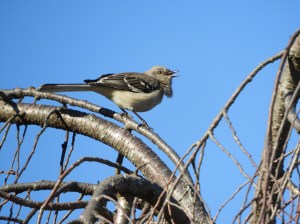 Northern Mockingbirds are famous for their expressive and varied songs, often mimicking other birds. All this month, whenever I have had occasion to walk in Inwood Hill Park or Sherman Creek Park, I’ve come across a loud mockingbird singing its heart out.
 - An Early Spring Preview of the Birds of Inwood
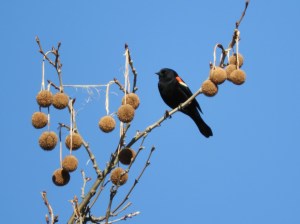 A burst of spring weather and unseasonably warm days brought a variety of birds to Inwood Hill Park in Northern Manhattan this week. The three days in early March— March 9 through March 11— felt like a gift, especially after a long winter of cold temperatures and abundant snow. Many New Yorkers talked about how… Read more: An Early Spring Preview of the Birds of Inwood
 - The Snowiest of Snows, and a Bald Eagle Appears
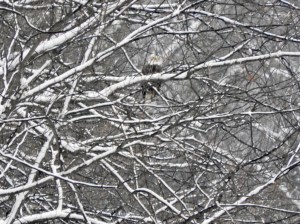 On Monday, February 23, the snow fell across New York City in steady downfalls over many hours, embedded in a winter storm that arrived late afternoon on Sunday and continued well into the afternoon. By the end, Central Park experienced one of the largest snowstorms in the city’s history. * Up here in Northern Manhattan,… Read more: The Snowiest of Snows, and a Bald Eagle Appears
 - Blizzard Warning: A Great Blue Heron Hunkers Down, and Other Stories of the Birds of Inwood in a Cold and Snowy Month
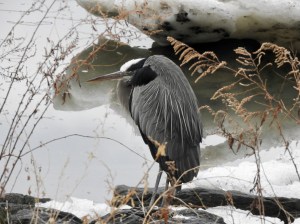 Northern Cardinals have resumed singing their song of spring this past week, so you would never know that NYC and parts of the Tri-State area are currently under a blizzard warning. As I write, the temperatures are mild, and the sky is blue. The blizzard warning is the first such weather alert issued for NYC… Read more: Blizzard Warning: A Great Blue Heron Hunkers Down, and Other Stories of the Birds of Inwood in a Cold and Snowy Month
 Birds of Inwood
Comments welcome!